
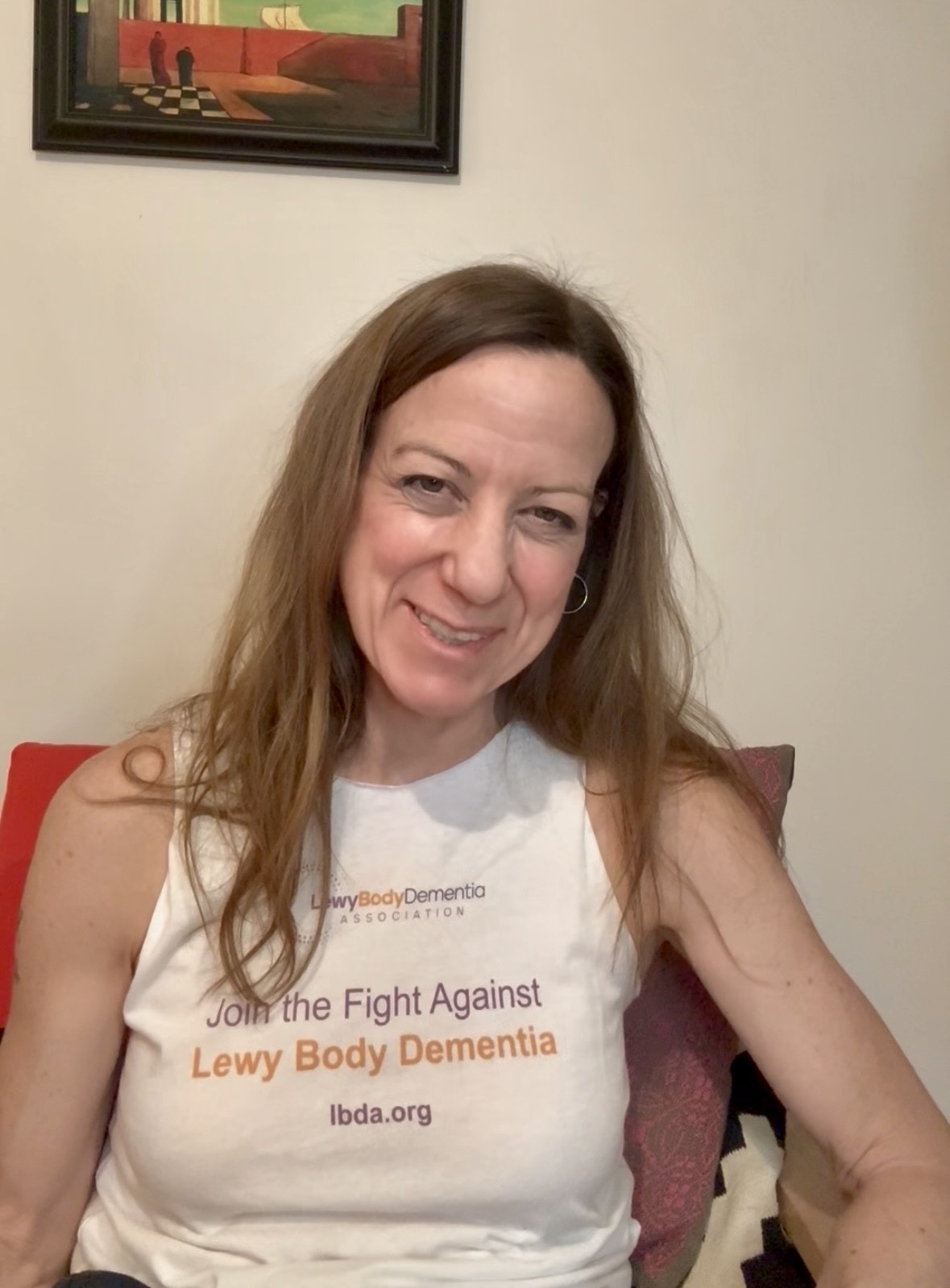
An interview with Skye White: Supporting caregivers and raising awareness of Lewy Body Dementia, PD, PDD
Biography
I was a project manager for 30 years and then I became the primary caregiver for my partner a few years ago as he got sick. He was eventually diagnosed with Lewy Body Dementia. The burden that I confronted on my own prior to diagnosis was challenging and isolating and it underscored to me how much daily practical help for caregivers is needed. That experience is why I started my business: to help other caregivers with any problem of daily overwhelm.
Please tell me a little about your background
My five siblings and I were mostly raised in Southern California. We had hardscrabble existences in our earlier years. I managed to transfer to UC Berkeley from community college in Oakland where I graduated with a degree in Latin American Studies. I went on to graduate school in Mexico and later lived in Western Europe. I moved to New York in 2006. I became active around Lewy Body Dementia only in recent years, which flowed from my partner’s situation.
Can you tell me more about your Advocacy?
I fought for almost two years to get an LBD diagnosis for my partner. We were finally able to get a “probable” diagnosis only in October of last year after a positive SYN-ONE test (I hope this test becomes more widely available). My experience with this and the medical system led me to want to fight to increase public awareness of LBD—the most common disease no one has ever heard of, including some doctors. I think the work of Robin Williams’ widow, Susan Schneider Williams, has been outstanding. I just started volunteering for the Lewy Body Disease Association. Their website and videos were vital for keeping me afloat and helping me achieve a diagnosis for my partner. I also support the Lewy Body Roller Coaster Podcast and I am part of its support groups—they are an absolutely amazing community of people. I participated in the PERSEVERE study out of Rush Medical College specifically designed for the caregivers of those with LBD and PD.
What is your passion and how did you get involved in Parkinson’s awareness and hope for a cure?
I feel passionate about supporting those with LBD, PDD and PD and their caregivers because for me it is personal. I got involved so that others don’t have the same negative experiences I have had. I’m not sure if a “cure” is possible, but I certainly think it is possible to achieve earlier detection and help people with these diseases to live longer and better, and to help their caregivers and families achieve better understanding and receive more support.
What type of goals do individuals with Parkinson’s have when seeing your Advocacy?
I’m just starting out in this journey in a public way. I hope that those with Parkinson’s and parkinsonism see the importance of more caregiver support, since these diseases affect the whole family, not just an individual with the disease. My goal is to continue to both help and learn from caregivers and from all those who are confronting Parkinson’s and parkinsonism. I also hope that there will be more resources available for those who are on their own confronting this disease and don’t have family or others to help them.
What effect can your Advocacy have on an individual with Parkinson’s?
My involvement is really on the caregiving side. Research shows that the best thing that can happen for those with LBD, PD and PDD is to have a solid, knowledgeable caregiver. The better off the caregiver, the better off the person with one of these conditions. I try to fight for myself to do this and help others do it. A caregiver who is in trouble and flailing is a big risk factor for increased medical problems in those with these diseases.
What would you like to see as a future goal for your Advocacy?
My present and future goal is to increase public awareness of LBD, PDD and PD. The public still has a lot of misconceptions. I want to normalize these diseases and fight against stigma, which has an isolating effect on those afflicted and their caregivers and families, and only reinforces the physical and mental challenges we already confront. I also want to increase understanding in the medical establishment, to approach these diseases in a way that is not just about finding the right meds, but about finding support for all the people involved. Doing things in that larger context would greatly improve the quality of life of patients and their families.
What events do you participate in?
I’ve participated in a number of conferences and webinars on Parkinson’s, Lewy Body Dementia and Dementia in general.
How does this also assist the caregivers?
Knowledge of the disease is vital for caregivers to be prepared and to plan ahead to ease this journey we are on. This is especially true with Lewy Body Dementia which is extremely unpredictable and has a large number of symptoms affecting all aspects of being.
How can someone get in touch? What is your website?
I work in the New York City area, but I also work with family members who do not live in New York City but are seeking help for their loved one who lives here. My e-mail is: skye@caregiverhelpernyc.com. My website is: caregiverhelpernyc.com.
How can others also become advocates for awareness?
There are a number of organizations for caregivers. I like the work of Caregiver Action Network (CAN) and the PERSEVERE study, which is specifically for caregivers of those with LBD and PD. I think it is important to volunteer and help support organizations that are taking up the cause of Parkinson’s and Lewy Body Dementia: the Parkinson’s Foundation, the Davis Phinney Foundation, and the Lewy Body Disease Association. I also love the programs for movement, which is so vital for Parkinson’s and parkinsonism: the New York-based modern-dance choreographer, Mark Morris, has a terrific program called Dance for PD that I love and I also follow Power for Parkinson’s—which has a lot of streaming videos.
In your opinion, what is the key to effective advocacy?
My perspective is that the best advocacy is personal and local. People will understand and engage when they feel devoted to a cause on a personal level.
What other activities do you undertake to help improve and support your daily living Eg exercise and alternative remedies?
I figure skate and I dance. I only took this up about four years ago. I love the ice and I can’t get enough of it. This is the way that I give back to myself in order to keep an even keel. I also think support groups and growing community is important. I’m part of a group for caregivers of those with Lewy Body Dementia and I also volunteer to help other caregivers at my local senior center.
Why should people who don’t have Parkinson’s care about this?
Increasing numbers of people have Parkinson’s, Lewy Body Dementia and related diseases and these numbers will continue to rise as the Baby Boomer population grows older. This disease can affect any of us and perhaps has already affected people we know. I have a friend who has early-onset Parkinson’s and another friend who died with it. My partner’s father and brother both had it.
If you had one song that would tell us more about you or represent your life, which song would it be?
That question is too difficult. I think different songs represent my life at different moments so I can’t think of just one.
If you had one final statement or quote you could leave for the Parkinson’s community, what would it be?
There’s a quote from modern dancer Martha Graham that I like, “The body says what words cannot”.
_______________________________________
TogetherForSharon® In memory of my mother, Sharon to voice awareness & hope for a Parkinson’s Disease cure. Sharon’s Son, George
Support https://www.togetherforsharon.com/shop/
Would you like to share your journey! Reach out and together our Voices are so much STRONGER!