
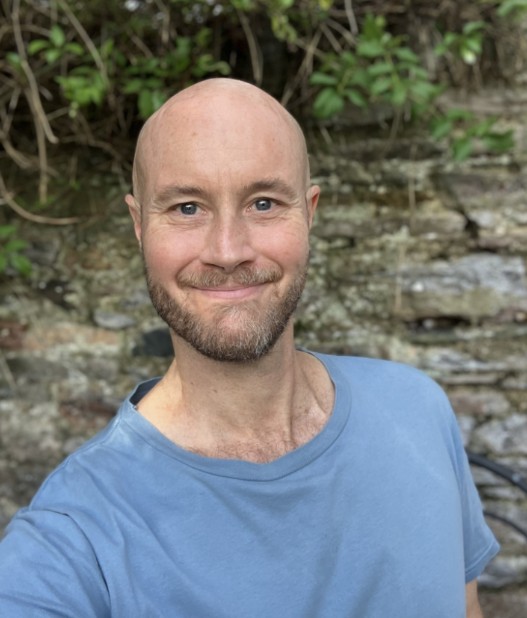
An interview with Scott Hickman, Parkinson’s and the Invisible Man
Biography
I worked as an actor when I lived in London. And taught yoga full time for 11 years.
Can you tell me more about your Advocacy?
I’m quite new to it; I’ve been running the channel for just over a year. I set up the channel hoping that it would resonate with as many people as possible from all walks of life, but especially those who feel that they don’t belong, and are struggling. My initial idea was to talk more about the emotional impact of receiving a diagnosis and living with Parkinson’s, with a focus on the mental health aspect; the invisible parts of the condition.
What is your passion and how did you get involved in Parkinson’s awareness and hope for a cure?
When I was diagnosed, my mother was diagnosed with terminal cancer shortly after. I relocated and was quite isolated. Single. Apart from my mother, I had no family support and didn’t have many friends around. I’m also gay so felt quite isolated in that respect too. I couldn’t find many people with Young Onset in similar circumstances to me telling their stories online and a lot of the messaging I did receive seemed to be for another generation who were married and heterosexual. I couldn’t find anyone who I felt I had much in common with in the community, publicly speaking about their experience of Parkinson’s. So my passion is to be a voice in the Parkinson’s community that I couldn’t find when I was diagnosed. I wanted to raise awareness of young onset Parkinson’s. But as a minority within a minority, I wanted to add my voice as a gay person. As the channel grew, I realized that it had a broader appeal and we can all find some connection from anyone’s story, whatever their circumstances.
What type of goals do individuals with Parkinson’s have when seeing your Advocacy?
I don’t know what they will bring because I’m not them. From the comments I’ve received I think people are looking to be validated in some way, heard, ‘seen’, inspired, comforted, and to just see someone living their life with the condition.
What effect can your Advocacy have on an individual with Parkinson’s?
I’m hoping it has a positive effect and makes anyone watching feel less alone.
What would you like to see as a future goal for your Advocacy?
I’m making this up as I go along!
What events do you participate in?
I went to ParCon (the annual Parkinson’s conference in the UK) last year. But I’m not much of a group person so I’m still finding my way with that. I would like to go on more demonstrations in London, but as I live in the South West of England, it’s quite a journey and I find busy environments with lots of people very overstimulating which causes my symptoms to ramp up. I’m also shy and a bit socially awkward, hence starting a YouTube channel where I can talk openly, but not directly to a group of people. Public speaking triggers my symptoms. Despite my background as an actor and teacher, both of which involved standing up and talking in front of large groups of people, presenting myself has never been easy, and is harder for me since being diagnosed.
How does this also assist the caregivers?
I’ve had messages from people who have family members or loved ones with Parkinson’s, and I think from those messages, they find something in my videos that matches their experiences. I hope my content has broad appeal, where people, including caregivers, can identify with some of the daily issues and struggles, as well as finding some form of comfort. Some caregivers have messaged me to say it’s helped them to understand and gain insight into their loved one’s experience of PD.
How can someone get in touch? What is your website?
On YouTube and TikTok: Parkinson’s and the Invisible man: https://www.youtube.com/@ParkinsonsandtheInvisibleMan. PD & the invisible man. https://www.tiktok.com/@theinvisibleparky
How can others also become advocates for awareness?
People come to it in their own time, when they’re ready, if they want to.
In your opinion, what is the key to effective advocacy?
On my channel I try to present a balanced picture of what my experience is. So I emphasize that Parkinson’s has actually been a positive in my life, but I don’t shy away from presenting the condition as it is.
How can we better fundraise to support a cure for Parkinson’s?
That’s a bit of a question and I’m not an expert in fundraising. I guess it needs to be as accessible to everyone as possible.
What other activities do you undertake to help improve and support your daily living Eg exercise and alternative remedies?
I walk. I hope to return to swimming. I do gentle yoga. I have a pretty good vegan diet. I try to minimize stress and keep life simple, and my expectations of myself reasonable.
Why should people who don’t have Parkinson’s care about this?
Chronic illness can happen to anyone at any time. Parkinson’s is the fastest growing neurological condition in the world, and many people are not aware until a relative or loved one develops the condition. There are still lots of myths and misunderstandings about Parkinsons’s. e.g., it’s not just old people who get it, it’s not just a tremor, and people who don’t understand that anyone can get the condition at any time in their life.
Have you had any family members or relatives affected by Parkinson’s disease?
My uncle recently died with Parkinson’s. He lived in Tasmania; I didn’t know him very well.
If you had one song that would tell us more about you or represent your life, which song would it be?
Tracy Chapman, All that you have is your Soul
If you had one final statement or quote you could leave for the Parkinson’s community, what would it be?
Be in the moment. Find joy in simple things. Hold on to the value and uniqueness of your own life.
__________________________________________
TogetherForSharon® In memory of my mother, Sharon to voice awareness & hope for a Parkinson’s Disease cure. Sharon’s Son, George
Support https://www.togetherforsharon.com/shop/
Would you like to share your journey! Reach out and together our Voices are so much STRONGER!