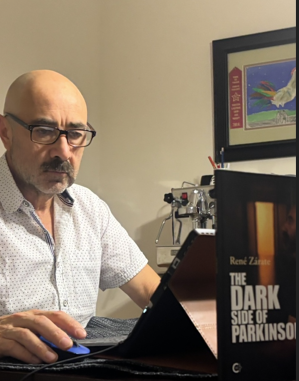
An interview with Rene Zarate, The True Dark Side of Parkinson’s Goes Beyond What We Imagine, What We Think We Know, and What We Believe We Understand.
Biography
I was born in Viña del Mar, Chile, and moved to the United States 32 years ago, where I built my own business and enjoyed an active life, especially playing tennis. Around 2017, I began noticing changes in my body that eventually led to my diagnosis with Parkinson’s disease, changing the direction of my life.
Can you tell me more about your Advocacy?
When I was diagnosed, I found that much of the information available did not fully explain what living with Parkinson’s was really like. I began writing notes from my own experience, and those notes eventually became The Dark Side of Parkinson’s, a way to educate, share information, and give a voice to realities that are often unseen.
What is your passion and how did you get involved in Parkinson’s awareness and hope for a cure?
My passion is creating awareness from lived experience and using what I have learned to help others understand the human side of disease. My broader goal is to develop an organization or foundation that can support vulnerable people and people with disabilities, not only those affected by Parkinson’s but also by conditions such as Alzheimer’s, cancer, autism, and multiple sclerosis.
What type of goals does individuals with Parkinson’s have when seeing your Advocacy?
I hope people with Parkinson’s see that their experience matters and that they are not defined only by a diagnosis. My goal is to encourage them to seek information, remain engaged in their lives, and recognize that sharing what they learn can also help others.
What type of training and how long are the programs?
At this time, I do not offer a formal training program with a fixed duration. My advocacy is based on lived experience, years of learning about Parkinson’s, sharing information, and developing educational and community-support initiatives.
What effect can your Advocacy have on an individual with Parkinson’s?
My advocacy tries to show that Parkinson’s affects much more than movement; it can also affect a person mentally, socially, financially, and physically. By speaking openly about these realities, I hope people feel better understood and are encouraged to seek information, support, and ways to keep moving forward.
What would you like to see as a future goal for your Advocacy?
My future goal is to continue developing Proyecto MiLA—Motivation, Integration, Leadership, and Adaptation—as a community initiative that can support people facing neurodegenerative diseases and other difficult circumstances. I want it to create practical support, human connection, and opportunities for people who may otherwise feel forgotten.
What events do you participate in?
I have participated in six clinical trials related to Parkinson’s disease, experiences that have allowed me to contribute personally to research and to learn more about the challenges of developing better treatments. I also use my writing and awareness work to participate in conversations that educate the community about Parkinson’s.
How does this also assist the caregivers?
Caregivers need information and understanding just as much as the person living with Parkinson’s. By explaining the physical, emotional, and daily realities of the disease, my advocacy can help caregivers approach their loved ones with greater understanding, patience, and compassion.
How can someone get in touch? What is your website?
At the moment, I do not have a website. I can be contacted at elladooscurodelparkinson@gmail.com or thedarksideofparkinson@gmail.com
How can others also become advocates for awareness?
Advocacy can begin by becoming informed, paying attention to what other people are going through, and sharing useful knowledge with respect. You do not need to have Parkinson’s to make a difference; listening, learning, and helping others understand can also create awareness.
What do we fail to see when we look only at the diagnosis and not at the person?
Awareness begins when we listen to lived experience, remember our roots, care about one another, and recognize that every person facing disease still has a voice, a history, and something to teach us.
In your opinion, what is the key to effective advocacy?
I believe the key to effective advocacy is education through real-life experience. We need to show people the side of Parkinson’s they do not normally see, while teaching, learning, and sharing information that can help patients, families, and caregivers.
How can we better fundraise to support a cure for Parkinson’s?
There are already many nonprofit organizations doing excellent work, and we should continue supporting their years of dedication, research, and advocacy. At the same time, I believe we must work together not only for Parkinson’s, but also for other neurological, neurodegenerative, and serious conditions, because every family facing disease deserves hope, research, and the possibility of a better future.
What other activities do you undertake to help improve and support your daily living Eg exercise and alternative remedies?
I believe exercise should always be adapted to each person’s abilities and limitations. For people with Parkinson’s, I personally value activities such as tennis and soccer because they encourage movement, coordination, and concentration, while safety and fall risk should always be considered when choosing any activity.
Why should people who don’t have Parkinson’s care about this?
I don’t believe we should force anyone to care simply because another person is living with a disease. Instead, we should build awareness, love, respect, and understanding, so that those who choose to support people with Parkinson’s, Alzheimer’s, or other neurodegenerative diseases do so genuinely and from the heart.
Have you had any family members or relatives affected by Parkinson’s disease?
Unfortunately, I am the first person in my family to be affected by Parkinson’s disease. However, I lost my mother to another neurodegenerative disease, so my family has experienced firsthand the impact these conditions can have on both the individual and those who love them.
If you had one song that would tell us more about you or represent your life, which song would it be?
I would choose “Gracias a la Vida,” written by Chilean singer-songwriter Violeta Parra, especially the interpretation by Argentine singer Mercedes Sosa. For me, it represents gratitude for life and everything it gives us, even though its most difficult moments.
If you had one final statement or quote you could leave for the Parkinson’s community, what would it be?
Along the journey of life, I have had the opportunity to enjoy and share many experiences, and I also came to know Parkinson’s disease—a disease that took away much of my hope and, at times, even my desire to keep going. I have done everything humanly possible to fight this disease, and I hope that by sharing my experience I can leave greater awareness behind so that others may not have to suffer what I have suffered.
TogetherForSharon® In memory of my mother, Sharon to voice awareness & hope for a Parkinson’s Disease cure. Sharon’s Son, George
Support https://www.togetherforsharon.com/shop/
Would you like to share your journey! Reach out and together our Voices are so much STRONGER!