
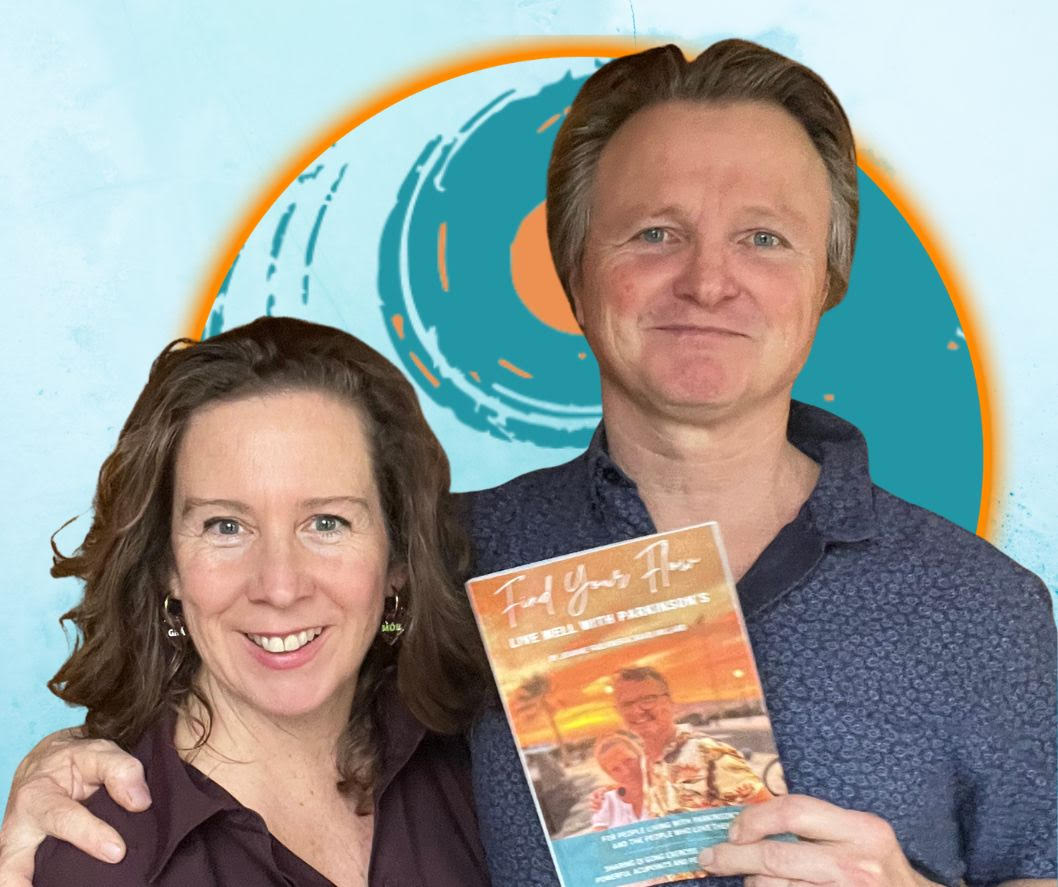
An interview with Joanne & Davy Faulkner: Find your flow. Live well with Parkinson’s
Biography
Jo:
I am a Shiatsu practitioner and Qi Gong teacher with over 35 years of experience in Traditional Chinese Medicine. My work focuses on the energy of food, acupressure, breathwork and movement. I created Chi Flow with Jo, a daily live online Qi Gong community that began during Covid and has grown into a global family of people practicing together each morning.
Alongside my professional work, I am also a wife to Davy, who lives with Parkinson’s. Our personal and professional lives are intertwined, and our work is grounded in lived experience, not theory alone.
Davy:
I was diagnosed with Parkinson’s in April 2016 at age 47. At the time I was active, involved in mountain rescue and very physical work. The diagnosis shook my identity. Since then, I’ve had Deep Brain Stimulation surgery and now manage my condition with medication, daily Qi Gong, food medicine, breathwork and a mindset of “just get up and do it.”
I am not a clinician; I am someone living with Parkinson’s every day. My voice comes from experience.
Can you tell me more about your advocacy?
Jo:
Our advocacy is about living well now. While we absolutely support research for a cure, we focus on empowering people with practical tools they can use daily. Through Qi Gong, acupressure, food medicine and community support, we help people reclaim agency over their bodies and emotions.
Our book, Find Your Flow: Live Well with Parkinson’s, and our online course are designed to give structured guidance and hope.
Davy:
Advocacy for me is honesty. Parkinson’s is unpredictable. Some days are smooth, some are hard. I speak openly about freezing, anxiety, medication, surgery, and mindset. I want people to know that you can still have joy, connection and purpose.
What is your passion and how did you get involved in Parkinson’s awareness and hope for a cure?
Jo:
My passion has always been helping people understand the connection between body, mind and spirit through Chinese Medicine. When Davy was diagnosed, Parkinson’s became personal. I didn’t want to just watch from the sidelines. I wanted to work with him, not against the condition.
Davy:
Hope for a cure is important. But hope for today is essential. My passion now is helping others not feel alone. Parkinson’s can isolate you. Community dissolves that isolation.
What type of goals do individuals with Parkinson’s have when working with you?
- Improve balance and reduce falls
• Decrease stiffness and tremor intensity
• Improve sleep
• Reduce anxiety and low mood
• Support digestion and constipation
• Build confidence in movement
• Create daily routine and structure
Many want to feel less robotic and more fluid again. Qi Gong helps reconnect them to rhythm and breath.
What type of training and how long are the programs?
Chi Flow with Jo is a LIVE Qi Gong exercise class that runs every weekday morning online, with daily recordings and monthly evening health talks.
Join here https://joannefaulkner.ie/product/chi-flow-with-jo-22/
Or try a free class and find out more. https://joannefaulkner.ie/chi-flow-with-jo/
We also provide free resources, including our Parkinson’s mini eBook https://livewellwithparkinsons.ie/freebies/
And of course our Find Your Flow; Live Well With Parkinson’s book / ebook & audio companion https://livewellwithparkinsons.ie/books-3/
https://shop.joannefaulkner.ie/#parkinsons
Our structured online course, Find Your Flow: Live Well with Parkinson’s, includes six live two hour sessions over twelve weeks, lifetime access to recordings, and one month of Chi Flow membership https://livewellwithparkinsons.ie/course-2/
Step 1:Join Whatsapp Pod
Step 2: Daily Live Qi Gong Sessions
Step 3: Weekly Live Coursework
Step 4 :Practical Tools Watch and practice the recordings anytime, simple, effective Qi Gong, Shiatsu Massage, Cooking, Breathwork, Meditations & more to support digestion, improve sleep, reduce pain, ease tremors & feel grounded.
What effect can your advocacy have on an individual with Parkinson’s?
Davy:
Confidence. When I can move smoothly in Qi Gong, I remember I can move smoothly in life.
Jo:
It restores sovereignty. People shift from “Why me?” to “What can I do today?” That shift changes everything.
What would you like to see as a future goal for your advocacy?
- More integration between Western neurology and complementary therapies
• Greater funding for movement based support
• Support programs that include partners and caregivers
• Community models that reduce isolation
What events do you participate in?
We participate in Parkinson’s Awareness Month activities, health talks, online webinars, community Qi Gong gatherings, and are preparing for international conferences including the World Parkinson’s Congress.
How does this also assist caregivers?
Parkinson’s affects relationships. Our course includes access for two people, the person with Parkinson’s plus a partner or caregiver
Caregivers learn tools to calm anxiety, improve sleep and use healing touch techniques. It becomes something shared, not something carried alone.
Joanne and Davy are LIVE online every weekday morning, showing up together to celebrate their bond and mutual support.
How can someone get in touch?
Website:
www.joannefaulkner.ie
www.livewellwithparkinsons.ie
Email: joanne@joannefaulkner.ie
Facebook https://www.facebook.com/livewellwithparkinsons
Instagram https://www.instagram.com/livewellwithparkinsons/
How can others also become advocates for awareness?
- Share real stories
• Support local Parkinson’s groups
• Fundraise for research
• Encourage movement programs
• Challenge stigma around visible and invisible symptoms
Advocacy begins with conversation.
If you could add any questions to this interview, what would they be?
- How do we redefine identity after diagnosis?
• What role does community play in neurological resilience?
• How can daily ritual transform chronic illness?
In your opinion, what is the key to effective advocacy?
Authenticity.
People do not need perfection, they need truth.
And collaboration. East and West medicine can work together, being complementary.
How can we better fundraise to support a cure?
- Story led campaigns
• Corporate wellness partnerships
• Movement challenges and community events
• Digital global participation events
• Transparent research updates
When people understand where money goes, they give more freely.
What other activities do you undertake to help improve daily living?
Davy:
• Daily Qi Gong
• Breathwork
• Walking with rhythm
• Deep Brain Stimulation
• Adjusted medication
• Magnesium, omega 3, black sesame seeds
• Fasting after 7pm, healthy diet
• Essential oils
• Meditation
Jo:
• Food medicine focusing on Liver and Kidney energetic systems (Bone broth, miso, seaweed for nourishment)
- Acupressure such as GB34 and GV16 for stiffness and internal wind symptoms.
We both garden and grow some of our own food
Why should people who do not have Parkinson’s care about this?
Parkinson’s is the fastest growing neurological condition globally. It affects families, workplaces and communities.
But more than that, Parkinson’s teaches something universal.
It teaches resilience.
It teaches compassion.
It teaches the importance of moving while we can, loving while we can, and living fully now.
Chronic illness is not separate from life. It is part of it.
And when one person learns how to live well despite challenges, it lights the way for everyone.
_________________________________________________________________
TogetherForSharon® In memory of my mother, Sharon to voice awareness & hope for a Parkinson’s Disease cure. Sharon’s Son, George
Support https://www.togetherforsharon.com/shop/
Would you like to share your journey! Reach out and together our Voices are so much STRONGER!