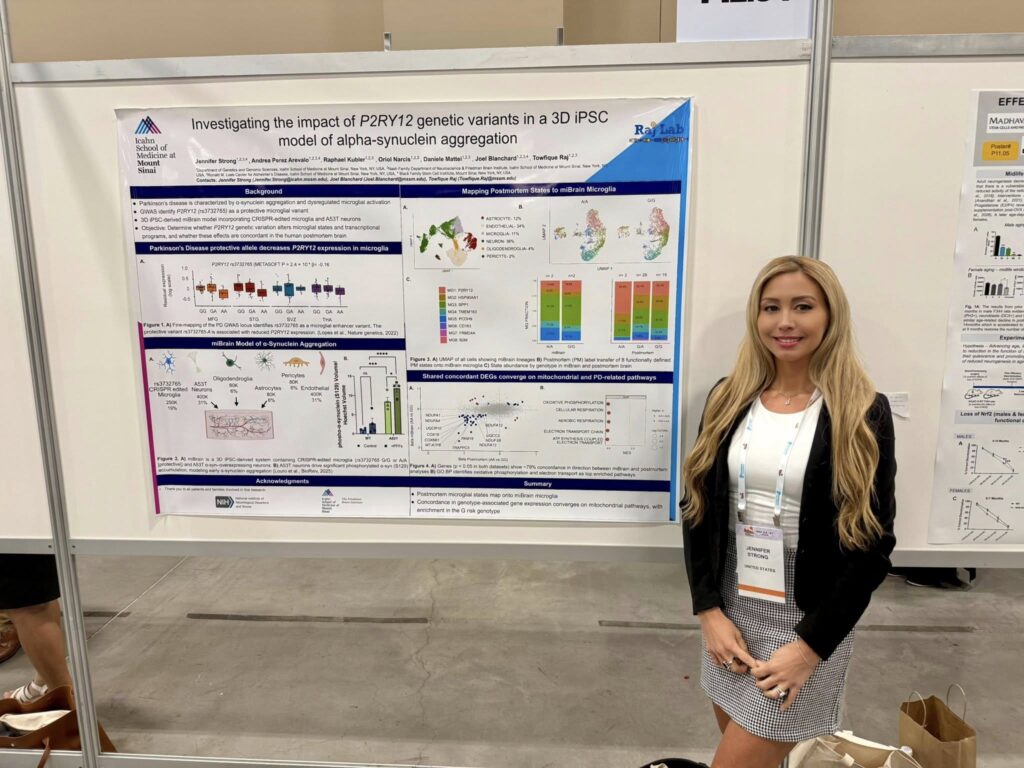
Biography
My path into neuroscience was nontraditional, and I returned to school after working for several years to pursue a career in research. During my undergraduate training at Rutgers University, I originally planned to become a neurologist, but experiences in several neuroscience laboratories showed me that research was where I could make the greatest contribution. I am now a Neuroscience PhD candidate at the Icahn School of Medicine at Mount Sinai, where my research combines molecular neuroscience and computational genetics to better understand Parkinson’s disease and contribute to developing future treatments.
Can you tell me more about your Advocacy?
My advocacy is rooted in connecting scientific research with the people it is intended to help. Volunteering for hospice and working in a neurology practice during college showed me the impact that neurodegenerative diseases have on patients and their families, and those experiences led me to pursue a career in neuroscience research. As my career develops, I hope to become more involved with patient-focused conferences and nonprofit organizations to help make research more accessible to the Parkinson’s community.
What is your passion and how did you get involved in Parkinson’s awareness and hope for a cure?
I’ve always been fascinated by the brain because it creates our experience of the world, yet we still understand remarkably little about how it gives rise to consciousness, thought, and memory. When I returned to school, I knew I wanted to dedicate my career to understanding the brain, and studying neurodegenerative diseases gave that curiosity a purpose I found deeply meaningful. Throughout my training, I sought out opportunities to study neurodegenerative disorders, but I found myself increasingly drawn to Parkinson’s disease because so many fundamental questions surrounding its genetics and biology remain unanswered.
What type of goals does individuals with Parkinson’s have when seeing your Advocacy?
I hope individuals with Parkinson’s feel that there are researchers who are deeply committed to understanding this disease and improving future treatments. Attending the World Parkinson Congress reinforced how important it is for research to be understandable and accessible to the people it is ultimately intended to help. I hope to help strengthen that connection by making research more accessible so that people living with Parkinson’s can better understand the discoveries being made and what they may mean for future treatments.
What type of training and how long are the programs?
My training began with a bachelor’s degree in neuroscience at Rutgers University, where I gained experience through research in four different neuroscience laboratories, volunteered in hospice supporting individuals with neurodegenerative diseases, and worked in a neurology practice specializing in Alzheimer’s disease and Parkinson’s disease. I am currently completing my PhD in Neuroscience at the Icahn School of Medicine at Mount Sinai, where I train in both molecular neuroscience and computational genetics while focusing my dissertation research on Parkinson’s disease. Doctoral training typically takes five to seven years and combines advanced coursework with full-time research, culminating in an original dissertation that contributes new knowledge to the field.
What effect can your Advocacy have on an individual with Parkinson’s?
I hope my advocacy reminds people living with Parkinson’s that behind every research project are scientists who genuinely care about improving their lives and future treatments. Scientific progress is often slower than any of us would like, but meaningful discoveries are happening every day, and each one brings us closer to understanding this complex disease. I also believe the people who inspire this research deserve to understand the discoveries being made and what they may mean for the future.
What would you like to see as a future goal for your Advocacy?
I would like to see stronger connections between researchers, clinicians, and the Parkinson’s community so new discoveries can be shared, understood, and ultimately translated into better care. I also hope to become more involved in patient-focused conferences and educational outreach that bring scientists and the Parkinson’s community together.
What events do you participate in?
I try to attend a mix of scientific and patient-focused conferences because they each offer a different perspective. Conferences like AD/PD and the New York City RNA Symposium allow me to learn about new technologies, computational approaches, and discoveries across neuroscience that can be applied to Parkinson’s disease research. Patient-focused meetings like the World Parkinson Congress provide a unique opportunity to connect scientific progress with the experiences and priorities of the Parkinson’s community.
How does this also assist the caregivers?
Volunteering in hospice gave me a greater appreciation for how much Parkinson’s affects entire families. I saw firsthand the emotional and physical burden that caregivers often carry. I hope my research contributes, even in a small way, to better treatments that can help ease that burden.
How can someone get in touch? What is your website?
To learn more about the research I am involved in, you can also visit the Raj Lab (https://rajlab.org) and the Blanchard Lab (https://labs.neuroscience.mssm.edu/project/blanchard-lab/), where I conduct my doctoral research at the Icahn School of Medicine at Mount Sinai.
LinkedIn: Jennifer Strong
https://www.linkedin.com/in/jennifer-strong-73755b267
Facebook: Jennifer Strong https://www.facebook.com/jenstrongg/
Instagram: @_jenstrong_ https://www.instagram.com/_jenstrong_/
How can others also become advocates for awareness?
Advocacy doesn’t require a scientific background. It can involve learning about Parkinson’s disease, listening to the experiences of people living with it, or volunteering with organizations that support the community.
In your opinion, what is the key to effective advocacy?
I think effective advocacy starts with listening, because you can’t meaningfully help people without first understanding what they need and what matters most to them.
How can we better fundraise to support a cure for Parkinson’s?
I think fundraising begins with awareness. The more people understand how Parkinson’s affects individuals and families, the more likely they are to support research. Every contribution, whether through donations, volunteering, or simply helping raise awareness, helps move Parkinson’s research forward.
What other activities do you undertake to help improve and support your daily living Eg exercise and alternative remedies?
I run a few miles every day, avoid processed foods, and spend as much time with my family as I can. I also read something every day, whether it’s a scientific paper or a book, because I’ve always enjoyed learning new things.
Why should people who don’t have Parkinson’s care about this?
I think people should care about others, even when something doesn’t directly affect them. At some point, all of us will experience illness or see someone we care about go through it, and compassion makes a difference.
Have you had any family members or relatives affected by Parkinson’s disease?
When I first began working in neurodegenerative disease research, I didn’t have a personal connection to Parkinson’s disease. While I was working in a neurodegenerative disease research lab, I met my boyfriend, and coincidentally, his father was diagnosed with early-stage Parkinson’s disease. His diagnosis has added a personal dimension to work that was already deeply meaningful to me.
If you had one song that would tell us more about you or represent your life, which song would it be? I’d probably choose “Satisfaction” by The Rolling Stones. It’s my boyfriend’s father’s favorite song, and he still gets up, grabs the microphone, and sings it whenever he has the chance. He doesn’t let Parkinson’s disease stop him from doing something he loves.
If you had one final statement or quote you could leave for the Parkinson’s community, what would it be?
Science takes time, but every discovery brings us closer to understanding Parkinson’s disease. I want to thank every person living with Parkinson’s who has participated in research or donated samples, because your generosity continues to shape discoveries that will benefit generations to come.
TogetherForSharon® In memory of my mother, Sharon to voice awareness & hope for a Parkinson’s Disease cure. Sharon’s Son, George
Support https://www.togetherforsharon.com/shop/
Would you like to share your journey! Reach out and together our Voices are so much STRONGER!