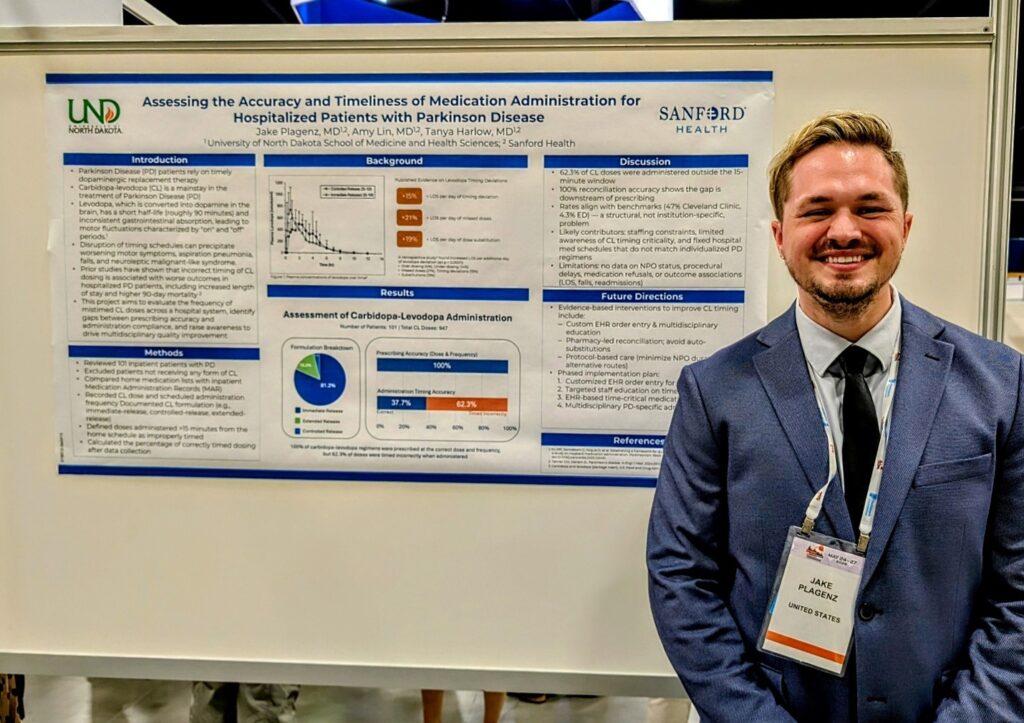
An interview with Jake Plagenz, On-Time Is Not A Luxury
Biography
Jake Plagenz, MD, is a third-year neurology resident at the University of North Dakota School of Medicine and Health Sciences, with plans to subspecialize in movement disorders. He earned his MD at the University of Washington and his B.A. in Biochemistry/Molecular Biology and Biology at Carroll College, and trained as a Postbaccalaureate Research Fellow at the NIH’s Rocky Mountain Laboratories. His research on medication timing for hospitalized patients with Parkinson disease was selected as a Hot Topics Oral Presentation at the 7th World Parkinson Congress, and he serves as a trainee representative on the Parkinson’s Foundation’s Hospital Care Standards Revision Work Group.
Please tell me a little about your background.
I’ve always been curious about how things work. That curiosity pulled me towards biochemistry at Carroll College in Helena, Montana, and ultimately into a career in medicine. During college, I was a hammer thrower for our track team. After this, I trained at the NIH’s Rocky Mountain Laboratories, where I worked in the lab of the late Dr. Byron Caughey on tests that detect the misfolded proteins behind Parkinson disease and related conditions. In medical school at the University of Washington, I volunteered as a harpist in the ICU and rehabilitation units, which taught me that medicine is not only about treatments. Today, I care for people with movement disorders as a neurology resident at the University of North Dakota.
Can you tell me more about your Advocacy?
My advocacy centers on people with Parkinson disease often don’t get their medications on time in the hospital. When we reviewed 101 hospitalized patients, 99 percent had at least one mistimed carbidopa-levodopa dose, and 62.9 percent of all doses were given more than 15 minutes off the home schedule. I now assist the Parkinson’s Foundation with revising its national Hospital Care Standards in addition to local Parkinson support group volunteering.
What is your passion and how did you get involved in Parkinson’s awareness and hope for a cure?
It started at the lab bench, working on tests that detect alpha-synuclein, the protein that clumps in Parkinson disease, and seeing how fast that science was moving. My movement disorders rotation in residency unified my interest as a clinician-scientist. Parkinson disease care is a long relationship, and you often become something close to a person’s primary doctor. I am optimistic, in an informed way, about a cure.
What type of goals does individuals with Parkinson’s have when working with you?
Most people want to keep doing what matters to them. My job is to turn those goals into a plan, which might mean adjusting medications, botulinum toxin injections for dystonia, therapy referrals, or involvement in an exercise program like Rock Steady Boxing.
What type of training and how long are the programs?
My own path is four years of medical school, four years of neurology residency, and a movement disorders fellowship I hope to begin in 2028.
What effect can your Advocacy have on an individual with Parkinson’s?
An on-time dose can be the difference between walking out of the hospital and leaving weaker than you came in. Beyond the hospital, I hope people with Parkinson disease feel more confident speaking up for their own care, and that our support group reminds them they are not doing this alone.
What would you like to see as a future goal for your Advocacy?
I would like on-time Parkinson disease medication to be something every hospital simply does, not something patients have to fight for. Longer term, I hope to build a career as a movement disorders physician-scientist, caring for patients while helping develop simple tests that guide earlier and more personal treatment.
What events do you participate in?
In 2026, I presented research at the World Parkinson Congress in Phoenix, the IAPRD Congress in Milan (upcoming), the International Congress of Parkinson’s Disease and Movement Disorders in Seoul, and the American Academy of Neurology Annual Meeting in Chicago. Locally, I am involved in our Parkinson Disease support group here in Fargo.
How does this also assist the caregivers?
Caregivers often become the keepers of every dose and every detail, and a hospital stay can take that control out of their hands. Better hospital standards let them rest instead of watching the clock, and support groups and boxing classes give them a community of their own.
How can someone get in touch? What is your website?
Email is the best way to reach me: jakob.plagenz@sanfordhealth.org. I don’t have a personal website.
How can others also become advocates for awareness?
You don’t need a title to be an advocate. Learn the basics and share one message: Parkinson disease medications need to be given on time, every time, including in the hospital. From there, volunteer at a support group or Rock Steady class, join a walk or fundraiser, or consider taking part in research.
If you could add any questions to this interview that you may want others to learn about, what would the question(s) be?
I would add: “What should someone with Parkinson disease do to prepare for a hospital stay?” Bring a written list of every medication with exact dose times, tell every nurse and doctor the medications are time-sensitive, and ask your neurologist for a hospital plan in advance.
In your opinion what is the key to effective advocacy?
Pair a real story with real data. After that, it comes down to listening first, keeping people with Parkinson disease at the table, fixing systems rather than blaming individuals, and staying persistent.
How can we better fundraise to support a cure for Parkinson’s?
Community events like walks and Rock Steady fundraisers make giving social, and supporting organizations that fund shared, open research, like the Michael J. Fox Foundation and the Parkinson’s Foundation, lets one gift power many studies. Above all, let people living with Parkinson disease lead the message.
What other activities do you undertake to help improve and support your daily living Eg exercise and alternative remedies?
Music and exercise keep me human. I take part in basketball, weightlifting, boxing, hiking, and biking. On Fargo’s most brutal days, bunkering inside with video games or binging trash TV with my partner. I also play harp, guitar, and drums.
Why should people who don’t have Parkinson’s care about this?
Parkinson disease is one of the fastest-growing neurological conditions in the world, so most of us will know someone affected by it. The problems it exposes, like hospitals struggling to give time-sensitive medications on time, affect every patient, and what we learn about how the brain ages may help with Alzheimer’s disease and related conditions too.
Have you had any family members or relatives affected by Parkinson’s disease?
No. My connection comes from my patients and their families, who trust me with some of the most personal parts of their lives.
If you had one song that would tell us more about you or represent your life, which song would it be?
While the song isn’t about me, I would choose “Black Balloon” by the Goo Goo Dolls. The final words and notes are tattooed on my forearm. It is remarkably special to my dad and I, as he was “required” to listen to it on repeat during drives between Wisconsin and Montana (mind you, that is roughly 61,200 seconds of Black Balloon.)
If you had one final statement or quote you could leave for the Parkinson’s community, what would it be?
Advocate for yourselves. The PD community knows affected loved ones more than anyone else. You are not alone, and you will always have someone in your corner.
TogetherForSharon® In memory of my mother, Sharon to voice awareness & hope for a Parkinson’s Disease cure. Sharon’s Son, George
Support https://www.togetherforsharon.com/shop/
Would you like to share your journey! Reach out and together our Voices are so much STRONGER!