
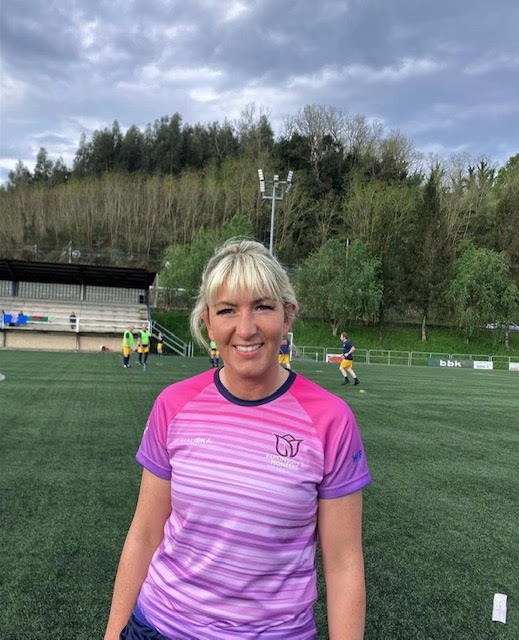
An interview with Gemma Darvill: Turning Parkinson’s into Purpose
Please tell me a little about your background.
I’m Gemma Darvill, 35 years old and mum to Hudson, aged 4. Football has always been my passion — I’ve coached and played for most of my life. I spent 10 years as a PE teacher and now work as a primary school teacher, which allows me to continue inspiring children through sport and education. I support Tottenham and I’m incredibly proud to be the England Parkinson’s Women’s Football Manager and Coach. Representing these women and being part of something so meaningful is one of my greatest achievements.
Can you tell me more about your advocacy?
My advocacy for Parkinson’s football is about championing an inclusive, active and supportive environment where people living with Parkinson’s can improve their quality of life through football.
It blends my lifelong love of the game with a deeper purpose — helping people with Parkinson’s feel stronger, more confident, connected and hopeful.
Football becomes more than just a sport. It becomes therapy, friendship, empowerment and identity. It shows that a diagnosis does not define you.
What is your passion and how did you get involved in Parkinson’s awareness and hope for a cure?
My dad was diagnosed with Parkinson’s over eight years ago, and he really struggled to come to terms with his symptoms and what the future might hold.
We discovered a team called Fighting Fit Football, and I took him along to a session. It changed his life — actually, it saved him. He found purpose again. He found his people. He found belief.
From that moment on, I became their biggest supporter, attending training sessions and tournaments. Then Annie Booth — a wonderful and inspiring lady living with Parkinson’s — asked if I would run an all-female Parkinson’s football team.
Football has always been my passion, so being able to use it to truly make a difference felt like everything had aligned. What started with supporting my dad turned into a mission to create hope for others.
What type of goals do individuals with Parkinson’s have when seeing your advocacy?
Many want to reduce or manage their symptoms through exercise, particularly improving balance, coordination and strength. But just as importantly, they want belonging.
Parkinson’s can feel isolating. Through football, we’ve created a powerful support network where women feel understood, supported and valued. They come for the exercise — but they stay for the community.
What type of training and how long are the programs?
We meet in Solihull once a month from 12:30–2:30pm, followed by a social. That social element is just as important as the training.
We have women travelling from London, Manchester, Devon, Milton Keynes and beyond — which shows how needed this space is.
We enter tournaments at St George’s Park, Bilbao, Glasgow and Cardiff, and we organise friendly matches to develop skills and confidence. We train in a supportive, adaptable way to meet different abilities while still maintaining high standards and ambition.
What effect can your advocacy have on an individual with Parkinson’s?
An improved life — physically, mentally and emotionally.
It can rebuild confidence, reduce isolation, improve mobility and give someone something to look forward to. It can remind them that they are still athletes, teammates, leaders and competitors — not just patients.
What would you like to see as a future goal for your advocacy?
More visibility. More TV coverage. More coaches getting involved. More funding and structural support.
I would love to see Parkinson’s football recognised nationally and internationally, with more opportunities for women specifically. Ultimately, I want it to become normal to see people with Parkinson’s playing football at every level.
How can someone get in touch? What is your website?
Instagram: @parkinsonspioneers
How can others also become advocates for awareness?
Start by listening. Learn about Parkinson’s. Support local groups. Volunteer. Share stories.
Advocacy doesn’t always mean leading something — sometimes it means amplifying voices, fundraising, raising awareness or simply showing up. If you have a platform, use it. If you have skills, offer them. If you have compassion, act on it.
In your opinion, what is the key to effective advocacy?
The key to effective advocacy is connecting passion with purpose — and turning it into clear, consistent action.
It’s about showing up, staying committed and bringing others with you.
How can we better fundraise to support a cure for Parkinson’s?
We need greater corporate sponsorship, stronger partnerships and more mainstream media coverage.
When large organizations support the cause, awareness grows — and with awareness comes funding, research and progress toward a cure.
What other activities do you undertake to help improve and support your daily living?
I play football and run regularly. Exercise is powerful — not just physically but mentally. Staying active keeps me strong so I can continue leading from the front.
Why should people who don’t have Parkinson’s care about this?
Parkinson’s does not discriminate. It can affect anyone, at any time.
We are all human and all equal. When we stand together for one condition, we stand together for humanity. Supporting Parkinson’s awareness means supporting families, communities and futures.
Have you had any family members affected by Parkinson’s disease?
Yes — my dad. He is the reason this journey began and continues.
If you had one song that represents your life, which would it be?
Sia Unstoppable
If you had one final statement or quote you could leave for the Parkinson’s community, what would it be?
Don’t ever give up.
There is strength in community, power in movement and purpose in persistence.
____________________________________________________
TogetherForSharon® In memory of my mother, Sharon to voice awareness & hope for a Parkinson’s Disease cure. Sharon’s Son, George
Support https://www.togetherforsharon.com/shop/
Would you like to share your journey! Reach out and together our Voices are so much STRONGER!