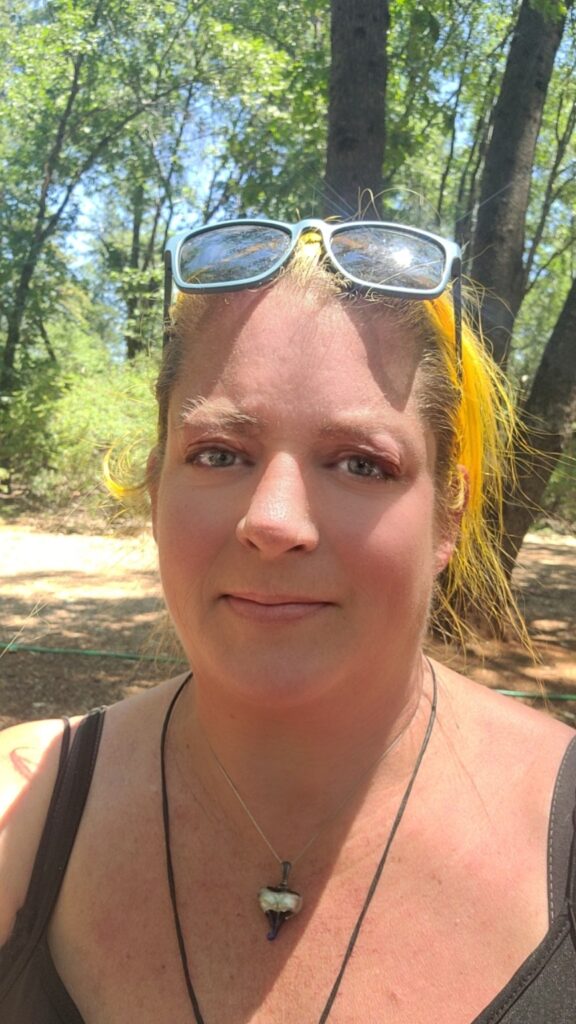
An interview with Eryn House, Cooking, Adaptation, and the Stubborn Art of Staying Independent
Biography
Eryn House is an author living off-grid in the Sierra foothills with Parkinson’s disease. She writes adaptive cookbooks and shares the honest, funny, and sometimes untidy reality of protecting independence when the body and brain stop following ordinary instructions.
Please tell me a little about your background.
I was diagnosed with post-traumatic Parkinson’s in 2023 after years of symptoms. I live off-grid at Camp Roozy, where cooking without conventional power and adapting to changing mobility helped shape both my advocacy and my cookbook series, This Should Be Easy.
Can you tell me more about your Advocacy?
My advocacy centers on practical independence, visibility, and humor. Through adaptive cookbooks, interviews, and social media, I show that people with Parkinson’s may need different tools or methods, but we still deserve access to creativity, dignity, and ordinary daily life.
What is your passion and how did you get involved in Parkinson’s awareness and hope for a cure?
My passion is helping people keep doing the things that make them feel like themselves, especially cooking. I became involved because Parkinson’s changed what I could safely do in my own kitchen, and the solutions I developed seemed too useful to keep to myself.
What type of goals does individuals with Parkinson’s have when seeing your Advocacy?
Many people want to remain independent, safe, useful, and connected to the life they had before diagnosis. I hope my work helps them replace the idea of giving up with the question, ‘How can I adapt this?’
What type of training and how long are the programs?
My advocacy is not a formal training program. The books provide practical strategies that readers can use immediately and revisit as their symptoms, energy, or abilities change.
What effect can your Advocacy have on an individual with Parkinson’s?
It can help someone feel less alone and less ashamed of needing shortcuts, adaptive tools, or help. It also offers concrete ways to make cooking safer and more manageable on tremor, fatigue, brain-fog, seated, or one-handed days.
What would you like to see as a future goal for your Advocacy?
I would like adaptive cooking to become a normal part of Parkinson’s education, occupational therapy conversations, and caregiver support. My larger goal is to build a practical library of resources that meets people where they are instead of asking them to perform wellness perfectly.
What events do you participate in?
I participate in interviews, online awareness efforts, author outreach, and Parkinson’s community conversations. I also share demonstrations, stories, and practical adaptations through my social media platforms and books.
How does this also assist the caregivers?
Caregivers often need realistic options that reduce risk, cleanup, decision fatigue, and conflict without removing every bit of independence. My approach gives them ways to support a person with Parkinson’s while still allowing that person to participate and make choices.
How can someone get in touch? What is your website?
People can find me on TikTok at @erynhouseauthor and on Facebook through Living Off Grid with Parkinson’s. My books and author information are available through my Amazon author page: https://www.amazon.com/stores/Erin-House/author/B0H4C3QPXN.
TikTok: @erynhouseauthor. Facebook: Living Off Grid with Parkinson’s.
How can others also become advocates for awareness?
Start by listening to people with Parkinson’s and sharing their lived experiences without turning them into inspiration decorations. Advocacy can be as simple as correcting misinformation, making spaces accessible, supporting research, or helping one person keep doing something that matters to them.
Why does adaptive cooking matter?
Food is more than nutrition; it is memory, identity, creativity, and connection, so helping someone remain involved in the kitchen can protect far more than a meal.
In your opinion, what is the key to effective advocacy?
Effective advocacy begins with listening and stays grounded in the real needs of the people affected. It should leave people with more understanding, more choices, and more dignity, not merely a memorable slogan.
How can we better fundraise to support a cure for Parkinson’s?
Fundraising works best when research goals are transparent and stories are paired with clear, practical ways to help. Small recurring donations, community partnerships, creative events, and wider participation from people outside the Parkinson’s community can turn awareness into sustained support.
What other activities do you undertake to help improve and support your daily living Eg exercise and alternative remedies?
I use pacing, seated tasks, prepared ingredients, freezer meals, simplified routines, and help from my partner to conserve energy and reduce risk. I also try to stay active within my physical limits and work with my medical providers rather than treating any alternative remedy as a substitute for care.
Why should people who don’t have Parkinson’s care about this?
Parkinson’s affects families, workplaces, caregivers, healthcare systems, and communities, not only the person diagnosed. The adaptations and accessibility changes that help us also make daily life safer and more humane for many older adults and people with other disabilities.
Have you had any family members or relatives affected by Parkinson’s disease?
No close family member had Parkinson’s before my diagnosis, so my family and I have had to learn this landscape together. That experience has shown me how important clear, practical information is for both patients and the people who love them.
If you had one song that would tell us more about you or represent your life, which song would it be?
‘I Won’t Give Up’ by Jason Mraz. It reflects the kind of stubborn hope that does not pretend life is easy but keeps choosing effort, connection, and another way forward.
If you had one final statement or quote you could leave for the Parkinson’s community, what would it be?
You are not failing because you need to do something differently. Adaptation is not surrender; it is how we keep a hand on the steering wheel when Parkinson’s keeps rearranging the road.
TogetherForSharon® In memory of my mother, Sharon to voice awareness & hope for a Parkinson’s Disease cure. Sharon’s Son, George
Support https://www.togetherforsharon.com/shop/
Would you like to share your journey! Reach out and together our Voices are so much STRONGER!