
Policing and Parkinson’s Disease: Encounters, Training, and the Need for Awareness And a new study by Dr. Alfonso Fasano and Dr. Moeed Zafer Syed: Have You Ever Been Mistaken for Being Intoxicated Because of a Neurological Condition?
Imagine being stopped while driving — or questioned while simply walking down the street — because someone assumed you were intoxicated. Now imagine that assumption was wrong.
For many people living with movement disorders, this is not hypothetical. Slurred speech, balance difficulties, tremor, slowed reactions, or involuntary movements can look like signs of alcohol or substance intoxication. Unfortunately, this misunderstanding can lead to embarrassment, stigma, discrimination, or even legal consequences.
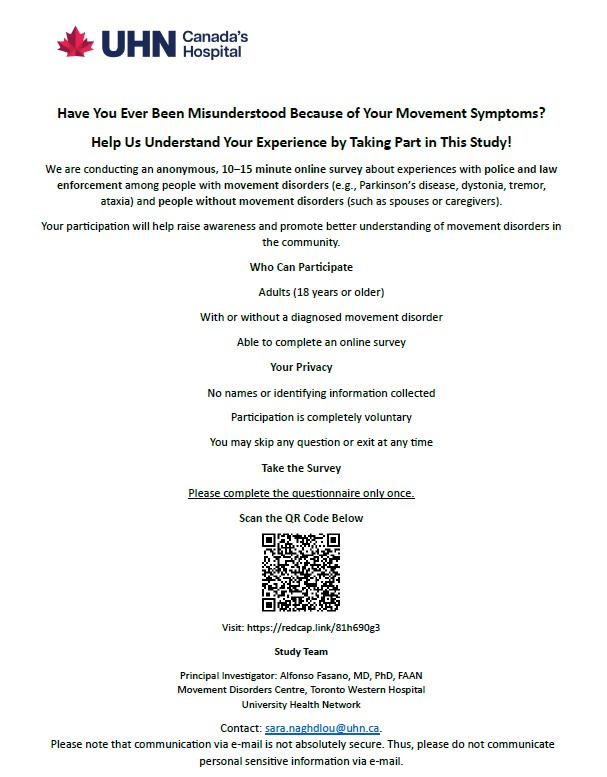
Dr. Alfonso Fasano and his research team are launching an important cross-sectional study to better understand how often this happens — and how it affects people’s lives.
Why This Research Matters
People living with:
- Parkinson’s disease
- Essential tremor
- Dystonia
- Ataxia
- Normal pressure hydrocephalus
often experience motor symptoms such as:
- Tremor
- Dyskinesias
- Gait instability
- Poor balance
- Slowed or slurred speech
To an untrained observer — including law enforcement, security personnel, or members of the public — these symptoms can resemble intoxication.
But how often does this misinterpretation happen?
What are the emotional, social, and legal consequences?
Are certain symptoms more likely to lead to misunderstandings?
Right now, we don’t have enough data to answer these questions.
About the Study
This is a cross-sectional survey study designed to:
- Measure how frequently individuals with tremor or balance disorders are misperceived as intoxicated
- Document experiences of discrimination while driving or walking
- Assess emotional and practical consequences
- Compare responses with caregivers (who will serve as controls)
The survey will be distributed broadly to individuals living with tremor disorders and balance conditions, as well as caregivers.
Participation is voluntary, confidential, and incredibly valuable.
Who Should Participate?
You may be eligible if you:
- Live with tremor, dyskinesia, ataxia, NPH, or another movement disorder
- Have experienced balance or visible motor symptoms
- Are a caregiver for someone with one of these conditions
Even if you have never experienced discrimination, your response is equally important. Understanding both experiences and non-experiences helps researchers paint an accurate picture.
Why Your Voice Matters
Without data, these experiences remain invisible.
Research like this can:
- Raise awareness among law enforcement and policymakers
- Inform educational initiatives
- Support advocacy efforts
- Reduce stigma
- Protect patients from future harm
Your story — whether challenging or uneventful — contributes to meaningful change.
Help Advance Research in Movement Disorders
Dr. Alfonso Fasano and his team are committed to improving the lives of people living with movement disorders. This study is one step toward addressing an underrecognized form of discrimination.
If you or someone you care for lives with tremor or balance difficulties, please consider participating and sharing this opportunity with your community.
Together, we can turn lived experiences into evidence — and evidence into change.
If you would like, I can also tailor this blog for:
- A hospital or university website
- A patient advocacy newsletter
- Social media promotion
- A more academic or more conversational tone
For more on my prior work please see
People with Parkinson’s disease (PD) and police often have unpleasant interactions that result from officers’ lack of awareness of the symptoms, for example, when tremors are mistaken for inebriation. In this research-based book, passionate Parkinson’s advocate Dr. George Ackerman describes initial police training and focuses on the great need in the law enforcement field for PD awareness. Officers’ shocking lack of awareness and symptoms can lead to highly unpleasant or even dangerous encounters for the PD sufferers. Through research, surveys, and interviews, Dr. Ackerman documents the lack of police training in PD and advocates its inclusion in all academy and in-service programs. Experiences of both police and PD citizens are recounted, and Dr. Ackerman offers advice and information to defuse potentially volatile situations, to counteract the fear of many people with Parkinson’s on meeting the police, and to promote mutual consideration and respect.
To order a copy https://togetherforsharon.com/policing-and-parkinsons-disease-encounters-training-and-the-need-for-awareness/