
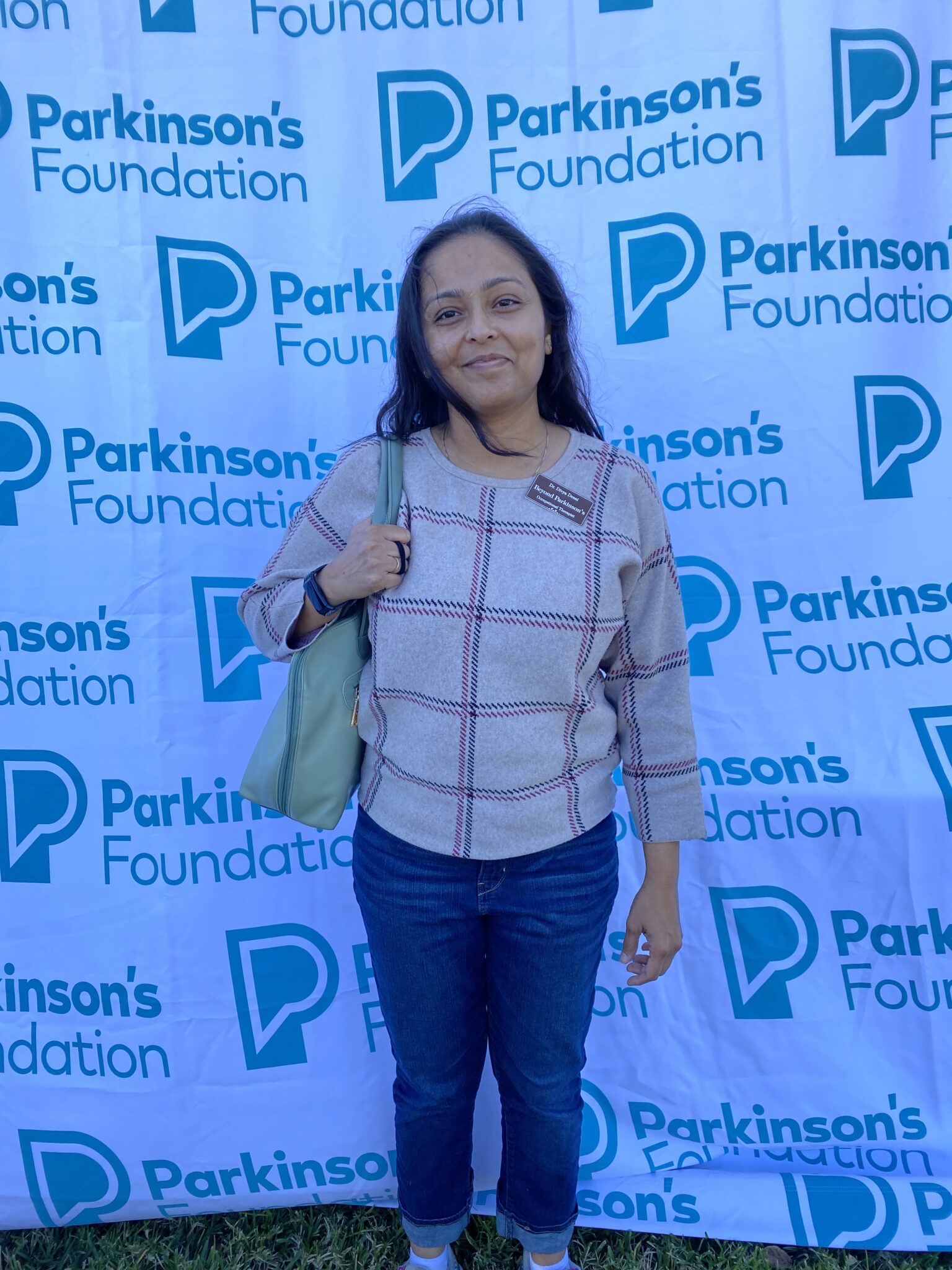
An interview with Divya Desai: Listening, Learning, and Advocating: An Occupational Therapy Perspective on Parkinson’s Care.
Biography
I am an occupational therapist, specializing in the rehabilitation of Parkinson’s disease. I am trained in the use of the LSVT-Big approach to care and have spent many years working directly with individuals living with Parkinson’s across the continuum of care. My current work bridges clinical practice, education, research, and advocacy, with an emphasis on advocating for the needs of menstruating individuals with YOPD.
Please tell me a little about your background.
My background is rooted in occupational therapy practice. I have worked clinically with individuals with Parkinson’s disease, focusing on functional mobility, daily routines, and quality of life. Over time, my role expanded into occupational therapy, education and research. I now teach future occupational therapists and mentor students on Parkinson’s-related projects and program development. This combination of clinical experience and academic work allows me to translate real-world challenges into evidence-informed education and advocacy.
Can you tell me more about your Advocacy?
I advocate through education, research dissemination, student mentorship, and community engagement. I routinely bring the students to our local PD support groups to deepen their understanding of the challenges this population faces. I also support our local Parkinson’s Association by developing occupational therapy doctorate capstone projects, aimed at improving access to services and the quality of life of PD patients. A key focus of my current advocacy is bringing attention to the unique needs of a subset of the PD community- the menstruating individuals with Parkinson’s Disease.
What is your passion, and how did you get involved in Parkinson’s awareness and hope for a cure?
My passion comes from working closely with individuals who are navigating Parkinson’s every day, not just the motor symptoms, but the emotional, cognitive, and social changes that often go unseen. Very early in my career, I worked with some PD patients who left a mark on my heart. Working closely with those amazing individuals challenged me to expand my clinical skills, get more training, and continue to leverage my contribution in the service of this population.
What type of goals does individuals with Parkinson’s have when working with you?
The beauty of working with occupational therapists is that the goals are always based on what is meaningful for each person. Of course, we do a basic assessment of strength, balance, activity tolerance, and challenges with the daily activities. But then we take it a step further. We look at the person’s roles, routines (which can vary significantly over the course of a day/ week), and rituals. Some of my favorite goals include a patient with PD (who never danced before), preparing a small dance routine to surprise his wife, another patient who wanted to take out a large trash can at the end of a downhill driveway, and one who wanted to get in and out of his jeep without feeling ‘stuck’ so that he can continue socializing with his friends.
What type of training and how long are the programs?
A typical LSVT-based program will last for approximately an hour, four times a week, for four weeks in a row. Some need more training than this. Some need a maintenance approach where I would see them once every other week to ‘refine’ their movement patterns. The intensity and duration of the program depend on the current abilities, the tolerance level (which does improve with time), and the goals established.
What effect can your Advocacy have on an individual with Parkinson’s?
Advocacy helps individuals feel seen, heard, and supported. It reinforces that they are not alone and that their experiences matter. With my advocacy efforts related to menstruation, I am hoping for more open and honest conversations between the patients, their neurologists/ MDS, and gynecologists, and better interdisciplinary communication in general. These communications can lead to better care coordination that our patients need and deserve!
What would you like to see as a future goal for your Advocacy?
I would like to see occupational therapy more consistently integrated into Parkinson’s care pathways and recognized as essential, not optional. I am also hopeful that there will be greater conversations at the global level about how hormonal fluctuations impact PD symptomatology, resulting in large-scale research related to the impact of hormone replacement therapy & PD.
What events do you participate in?
I participate in educational events within my profession, conferences (such as the AD/PD Conference & the WPC), student-led initiatives, and Parkinson’s-related awareness and research activities. Locally, I participate in the events arranged by the Parkinson’s Association of Northern California, various Parkinson’s Support Groups, and Table Tennis for Life.
How does this also assist the caregivers?
I collaborate with my students to create specific resources for the caregivers. These are geared towards the caregivers taking care of their own physical and mental health.
How can someone get in touch? What is your website?
I don’t actively treat patients at this time. However, I am happy to answer any questions you may have for me. My email address is ddesai@pacific.edu
How can others also become advocates for awareness?
Advocacy starts with listening and learning from individuals with Parkinson’s and their care partners. Others can participate in many awareness campaigns by the Michael J. Fox Foundation, Parkinson’s Foundation, YOPD Support Groups, and their local organizations supporting patients and their caregivers. Those who are willing and able to, can support PD-related research by donating funds to further the research. Many local and national campaigns arrange for awareness walks. Showing up to one of these events tells the patients and their caregivers that they are not alone.
In your opinion what is the key to effective advocacy?
Consistency & authenticity.
How can we better fundraise to support a cure for Parkinson’s?
Greater transparency in how funds are used, along with broader representation of different approaches to Parkinson’s care, could strengthen fundraising efforts. While medications are an important part of treatment, many individuals, especially in the early stages, also value non-pharmacological approaches such as exercise, which has growing evidence to support its benefits. Ensuring that patients and caregivers have a voice in funding priorities may help create more balanced investments and more meaningful engagement in fundraising initiatives.
What other activities do you undertake to help improve and support your daily living Eg exercise and alternative remedies?
As an adult in her midlife, I struggle with managing multiple responsibilities. But I do practice what I preach. I take the time to exercise, go on walks, socialize with friends, and maintain healthy eating habits.
Why should people who don’t have Parkinson’s care about this?
Parkinson’s affects families, communities, and healthcare systems, not just individuals. The incidence rate of PD is continuously rising. For that reason, people who don’t have PD should care about it, so that the future generation can be protected.
Have you had any family members or relatives affected by Parkinson’s disease?
Yes, a distant relative.
If you had one song that would tell us more about you or represent your life, which song would it be?
“Come Alive” from The Greatest Showman
If you had one final statement or quote you could leave for the Parkinson’s community, what would it be?
You are more than your diagnosis. Your goals, stories, and everyday victories matter. You are not alone, and we deeply care about you.
___________________________________________
TogetherForSharon® In memory of my mother, Sharon to voice awareness & hope for a Parkinson’s Disease cure. Sharon’s Son, George
Support https://www.togetherforsharon.com/shop/
Would you like to share your journey! Reach out and together our Voices are so much STRONGER!