
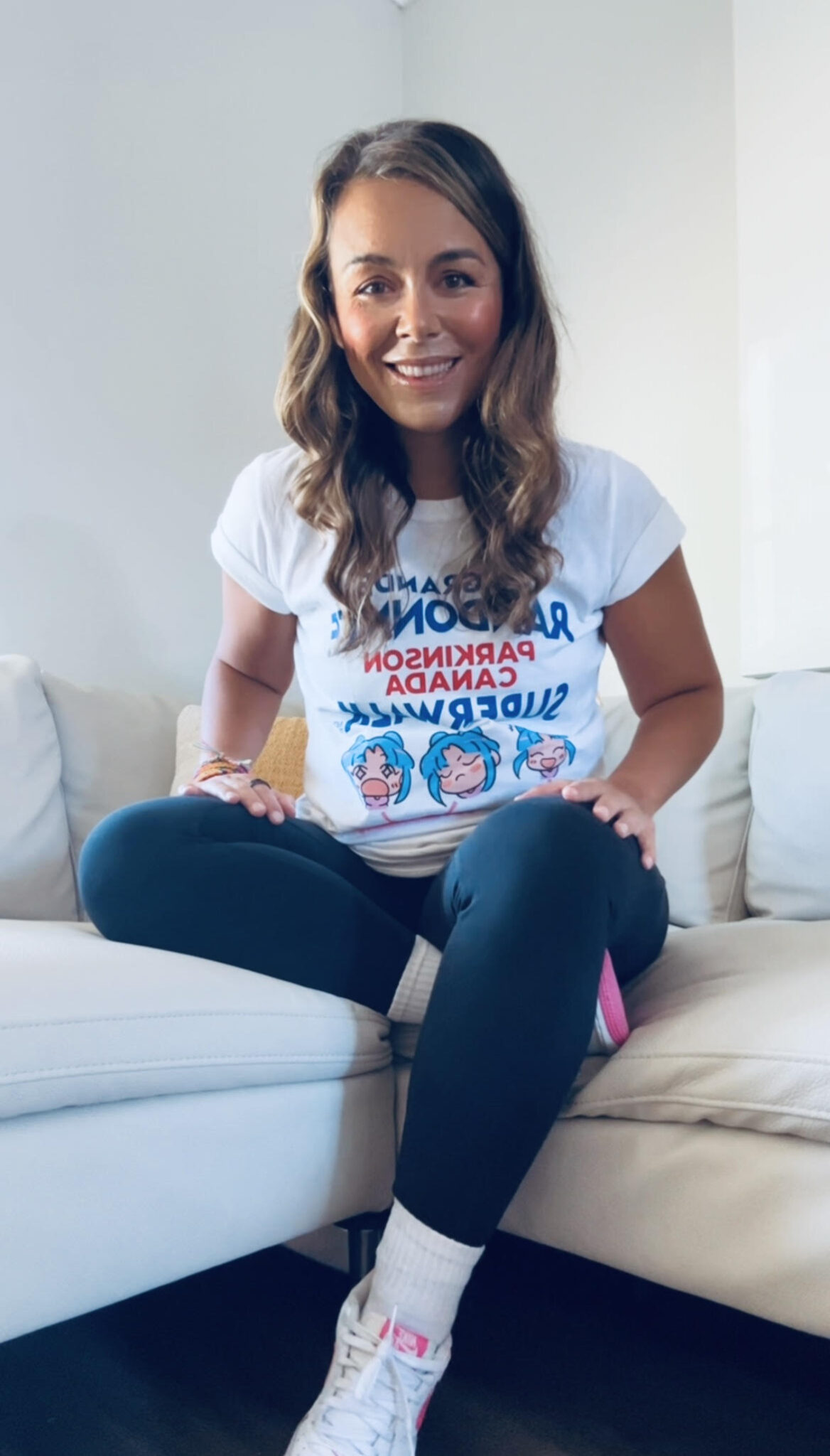
An interview with Diana Rodriguez: A Journey of Resilience: Focusing on the Beauty of Each Day, Holding on to the Blessings, and Choosing Positivity as the only Way of Life
Biography
I was born and raised in Colombia and moved to Canada as a teenager. From a very young age, I’ve been a positive, free-spirited person who has always found comfort, joy, and passion in artistic expression.
I am currently a 40-year-old mother to a 12-year-old boy. Creativity has always been a central part of who I am. I began my career as a makeup artist, and my artistic side continues to show through theatre and special-effects makeup, painting, drawing, and creating visual designs on the computer—though these have become increasingly challenging as my PD progresses. . These are the activities where I truly lose track of time and experience both relaxation and joy.
Early in my career, I realized that freelancing as an artist was not my preferred path for long-term stability, so I leaned into the business side of my education, which was the other half of my degree. Over the past two decades, I have managed and worked extensively within the beauty industry.
Today, I work as a business coach for a franchise system in Canada, where I support franchise partners throughout their journey as business owners. This role allows me to combine my creative background with my business expertise, helping others grow with confidence and clarity.
Can you tell me more about your Advocacy?
My advocacy is deeply rooted in my belief that we are never given more than we can handle, and that within every challenge—whether good or bad—there is a greater purpose and often hidden blessings. From the moment I knew I had Parkinson’s disease my mind was automatically thinking “What can I do? Who can I help? What is my greater mission?”
Since then, I have committed myself to learning, advocating, and taking meaningful action. Every day, I take steps toward supporting others living with PD, increasing awareness and understanding, and contributing—wherever possible—to research aimed at finding a cure.
I currently co-host a monthly support group for people with Parkinson’s disease, participate in the Michael J. Fox Foundation’s PPMI research program, and in 2024 co-hosted the Parkinson’s SuperWalk in my area to raise both awareness and funds for PD research.
In addition, I founded PD Unshaken, a blog dedicated to showcasing the warriors within our community. This space focuses on the heart and soul of individuals living with PD, honoring their stories, resilience, and humanity beyond the diagnosis.
I continue to actively seek opportunities to give back and to transform the challenges and losses that PD brings into something meaningful and purposeful. I fight not only for myself, but for the incredible people I’ve met along this journey, for future generations, and for a future where Parkinson’s disease exists only in textbooks.
What is your passion and how did you get involved in Parkinson’s awareness and hope for a cure?
My passion comes from a deep belief that we are never given more than we can handle, and that every challenge carries a greater mission. Even before my official diagnosis, I sensed that Parkinson’s disease had entered my life with a purpose beyond myself.
From that moment, I knew my role was to find ways—big or small—to help others navigating this journey. That belief led me to become involved in Parkinson’s awareness and advocacy, driven by a desire to offer hope, connection, and understanding, while also supporting efforts toward research and ultimately a cure.
What type of goals do individuals with Parkinson’s have when seeing your Advocacy?
Individuals with Parkinson’s often seek connection, understanding, and hope when they encounter my advocacy. My goal is to help people feel less alone by creating a space that goes beyond the technical aspects of Parkinson’s—such as symptoms, medications, and treatments.
I strive to foster a sense of genuine connection where emotions are validated, humanity is honored, and the experience of navigating hardship is acknowledged. Through this space, individuals can find reasons to smile, regain strength, and remember that continuing to move forward and fight is meaningful and worthwhile.
I want anyone in the Parkinson’s community to know that they can feel comfortable reaching out to me—as a listening ear, a supportive shoulder, and a non-professional but open and honest voice sharing my lived experience. I feel like people in the community as well as others seek me out because of my ability to remain positive and be an optimist. My ability to see blessings and the light in all the darkness that we’re going through. And I think that’s something that people seek out and find with me.
What effect can your Advocacy have on an individual with Parkinson’s?
My advocacy can help individuals with Parkinson’s feel less alone and more understood while creating more awareness & knowledge about PD outside of the PD Community. By sharing lived experience and fostering open connection, I hope to remind people that they are not alone in their journey.
I also believe advocacy empowers individuals to use their own experiences and stories to create awareness. Through awareness, we gain deeper understanding of this complex disease—an essential first step toward improved treatments and, ultimately, a cure.
Beyond awareness, my advocacy can help individuals rediscover purpose. It encourages them to continue pushing forward, to thrive, and to believe that defying the odds is possible. By offering hope, connection, and meaning, I aim to help others recognize their strength and the value of their voice.
What would you like to see as a future goal for your Advocacy?
I hope to reach and positively impact as many people as possible. I want to continue spreading awareness by sharing my lived experience, helping others better understand what individuals with Parkinson’s truly go through—beyond what is often visible.
I also hope to support and uplift people through personal connections, whether that’s by meeting individual one-on-one, participating in events, or engaging in advocacy efforts in any capacity available to me. Each interaction is an opportunity to help someone feel seen, supported, and empowered.
Advocacy also is a gift to me as I meet people who change my life and perspective for the better. Advocacy, to me, is not just about giving, it’s also about growing, learning, and building meaningful relationships that strengthen both myself and the community as a whole.
What events do you participate in?
I co-host a monthly support group, organized an co-hosted a PD Super walk, through PPMI I have the opportunity to join PPMI evens (although due to work/travel conflicts I have not been able to attend) I have gone to Parkinson’s IQ and you and truly try to make it to any and all events near me.
How does this also assist the caregivers?
I truly enjoy working with and connecting with caregivers. As I’ve shared before, I’m an open book, and I value giving caregivers a safe space to ask questions and openly share any fears, frustrations, or emotions they may be carrying.
By offering them the time and space to talk with me from a Parkinson’s point of view, caregivers can gain insight and understanding without the fear of hurting, or stepping into sensitive territory with their loved ones. My hope is that these conversations help caregivers feel supported & validated.
How can someone get in touch? What is your website?
IG- @pd_unshaken or
@dianak10r
How can others also become advocates for awareness?
I believe advocacy begins with curiosity and connection—by taking time to research what’s happening in your local area and within the broader community, and by finding a medium that feels both comfortable and meaningful to you. Advocacy looks different for everyone, and it’s important to choose a path that aligns with your passion, availability, and strengths.
From there, it starts with using your voice. Sharing your experiences, your knowledge, and what you’ve tried—what has worked and what hasn’t—can be incredibly powerful. Our voices matter, and they carry the potential to help others feel understood and supported.
Advocacy also requires courage: the willingness to speak without fear of judgment or criticism, and to share from a place of genuine intention—to help others. Many people will relate, many will feel encouraged, and many will applaud the effort simply because it comes from authenticity and care.
Ultimately, advocacy is about standing together, and not being afraid to speak up. Using our voices to raise awareness is essential, especially with a disease as complex and misunderstood as Parkinson’s.
How can we better fundraise to support a cure for Parkinson’s?
To better fundraise I think we need better understanding of PD, I think many people see and think of Parkinson’s as shaking, so they don’t see it as a big deal or impairment. The progression of PD is considered slow but they don’t realize many of the symptoms are invisible to the external eye, and the truth is living with PD is hard, it’s debilitating, it’s painful.
A cure will only come when the reality of Parkinson’s is fully seen, fully understood, and treated with the seriousness it deserves. When it’s seen as a minor or slow progressing condition, urgency is lost — and with it, funding.
What other activities do you undertake to help improve and support your daily living Eg exercise and alternative remedies?
I am deeply committed to staying as physically and mentally active as possible. I do strength training at least three times a week because exercise is currently the only proven way to slow the progression of Parkinson’s disease. As this condition gradually takes away movement and control, I feel a strong responsibility to use my body fully while I still can. If movement is something that will be lost, then I want to honor it now.
I am very mindful of what I put into my body. I choose clean, healthy, organic and natural foods and avoid sugar wherever possible. This is another way I care for myself and support my overall wellbeing.
Mindfulness and gratitude have been part of my life for many years, but since living with Parkinson’s, these practices have taken on a much deeper meaning. I consciously tune into my body, appreciate what it can still do, and push myself in the present moment. I don’t wait for Mondays, the new year, or a time when things feel easier. With a progressive condition, there is no guarantee of “later,” so I choose to show up fully today.
For me, this is not about overdoing things — it’s about preserving independence and hope. Every effort I make now is an act of self-respect and determination to live as well as I can, for as long as I can.
Why should people who don’t have Parkinson’s care about this?
I often say: don’t wait for life-changing news to start taking care of yourself. So many of us slowly drift away from our passions and joy, slipping into autopilot, tiredness, and survival mode. Exercise, mindful eating, and self-care become the first things we push to the bottom of the list.
But the truth is, without health, nothing else truly holds its value.
Parkinson’s has stripped away the illusion of “later” for me. It has made me acutely aware that movement, clarity, and independence are not guaranteed. What I live with now is what many people take for granted every day. Caring about this isn’t about fear; it’s about awareness. It’s about choosing to honor your body and mind while they are still working for you, not after they start failing. Health is the foundation that allows everything else.
If you had one song that would tell us more about you or represent your life, which song would it be?
My song is in Spanish 😉 it’s MILAGROS from Karol G.
If you had one final statement or quote you could leave for the Parkinson’s community, what would it be?
No matter how hard this journey becomes, stay open to the blessings it carries. Practice gratitude for what is, for what will be, and for what once was — even the parts that will never be again.
____________________________________________
TogetherForSharon® In memory of my mother, Sharon to voice awareness & hope for a Parkinson’s Disease cure. Sharon’s Son, George