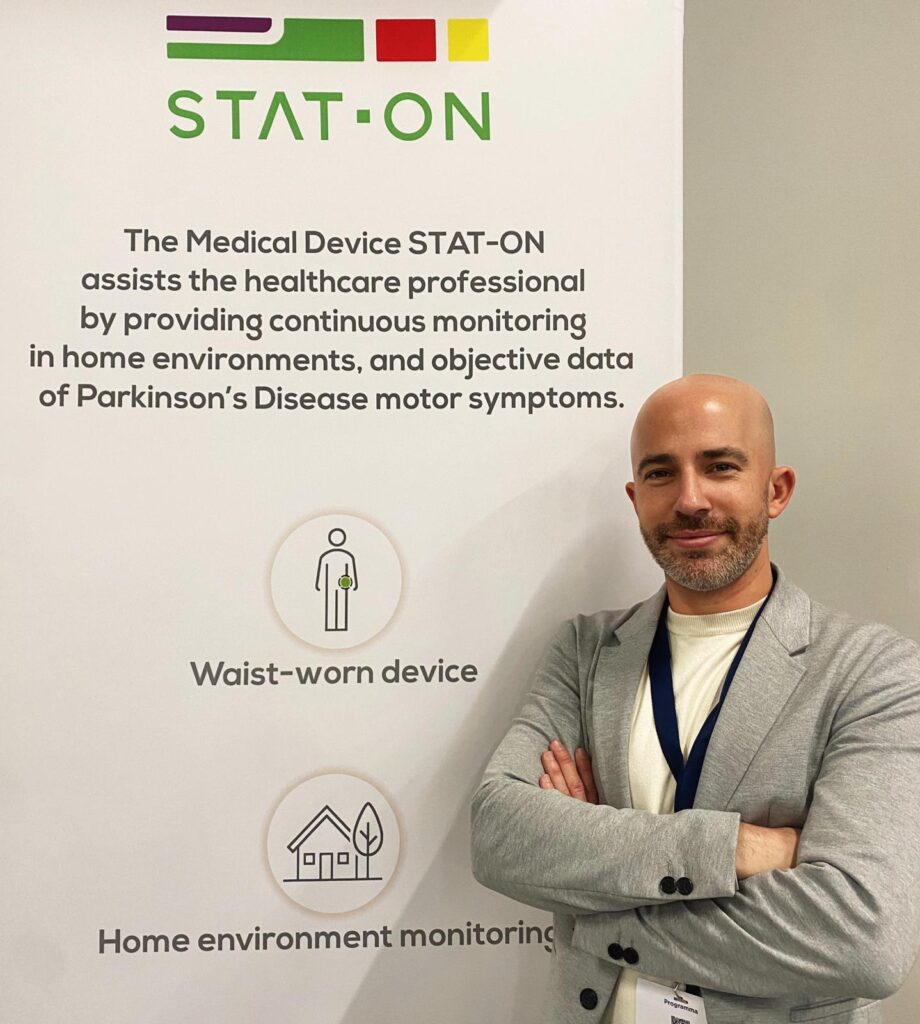
An interview with Daniel Rodríguez-Martín, PhD, From Concept to Clinical Impact: Changing the Paradigm of Parkinson’s Evaluation
Biography
Chief Executive Officer and member of the Management Board at Sense4Care, Daniel holds a PhD in Automatic Control, Vision and Robotics from the Universitat Politècnica de Catalunya, awarded Cum Laude in 2014. He previously completed degrees in Industrial Electronics and Industrial Automation, both with honors, and an MSc in Automation and Robotics, where he achieved the highest distinction for his Master’s thesis.
His research career has focused on inertial sensing systems with embedded real-time algorithms. He has worked extensively on machine learning approaches to detect motor symptoms in Parkinson’s disease, including activity patterns, falls and posture transitions. Over the years, he has supervised multiple degrees and master’s theses, and authored more than 60 scientific publications, participated in national clinical books and guidelines, while participating in several national and international research projects.
Since 2017, he has led the industrialization and medical certification of Sense4Care’s technology, supported by a €1M SME Instrument Phase II grant, among others. He led the development of the company’s ISO 13485 quality system and secured CE marking under both MDD 93/42 and MDR 2017/745. In parallel, he has driven the global commercialization of the company’s devices, expanding into more than 23 countries and establishing strategic agreements with leading pharmaceutical companies and Hospitals.
In 2020, he completed an MBA, further strengthening his expertise in business strategy, marketing and leadership.
Can you tell me more about your Advocacy?
Since 2009, I have worked closely with Parkinson’s patients, caregivers and clinicians, which made me realize the gap between what patients experience and what we actually measure in clinical practice. That led us to develop tools that objectively quantify symptoms and improve decision-making.
After launching our device in 2019, we began to see real impact on patients’ quality of life, which reinforced our mission despite building everything with limited resources as an independent company.
For me, advocacy means pushing for a shift toward objective, data-driven care, working with clinicians and patient organizations to bring innovation into real-world practice.
What is your passion and how did you get involved in Parkinson’s awareness and hope for a cure?
Everything started in 2009 when I joined a research group at the Universitat Politècnica de Catalunya, which shifted my focus from engineering to healthcare. Working closely with patients, caregivers and clinicians made me realize how complex and invisible Parkinson’s symptoms are, and motivated me to make them measurable to improve care.
That naturally led me into both technology development and advocacy, pushing for better awareness and more objective, data-driven approaches. I stay driven by the hope that one day a cure will be found, and that the people I’ve met along the way will finally see a real light ahead.
What type of goals do individuals with Parkinson’s have when seeing your Advocacy?
Individuals with Parkinson’s often want to better understand and communicate their symptoms, especially given how much they fluctuate day to day. Thanks to objective monitoring with our sensor, patients can approach visits with their neurologists more confidently, explaining their symptoms with much greater clarity and precision.
This leads to more productive consultations and better-informed clinical decisions. Ultimately, their goal is to gain more control over their condition and improve their quality of life.
What type of training and how long are the programs?
To properly understand the STAT-ON sensor, we provide tailored training for clinicians or health professionals. This includes how to use the device and interpret the reports, typically through sessions that can range from 1 hour to more structured training depending on the center.
They have the responsibility to make the patient understand our reports and how they can improve based on the results obtained.
What effect can your Advocacy have on an individual with Parkinson’s?
Our advocacy helps bring objective measurement into everyday Parkinson’s care. By using STAT-ON to monitor patients and capture their daily symptoms, we provide much more precise and continuous information than traditional assessments.
This allows healthcare professionals to better understand each patient’s condition and adjust therapies in a more personalized and effective way. Ultimately, this leads to improved clinical outcomes and quality of life for patients.
What would you like to see as a future goal for your Advocacy?
Personally, I’d like that STAT-ON could become the world gold standard in every clinical study. Today, clinicians use a diary or questionnaires, which leads to biased studies. I’d like to see objective and accurate results to create better therapies. STAT-ON was built for this, and as leader of the project, I’d like it to be a reality.
What events do you participate in?
We are a small company, so we prioritize attending local and national Parkinson’s congresses, and then aim to participate in larger international events whenever the budget allows.
How does this also assist the caregivers?
I remember a caregiver telling me that the STAT-ON report felt like a mirror of her husband’s condition. They had always struggled to explain fluctuations, freezing episodes and dyskinesia, but with a simple visual report they could clearly see both the severity and when these symptoms occurred.
How can someone get in touch? What is your website?
I recommend Linkedin. I’m very active there and I read all the messages except those who try to sell me things. You can find me directly via Linkedin, or through our website in the “about us” section. Our website is www.Sense4Care.com
How can others also become advocates for awareness?
We participate in several projects with associations. We try to create a workflow between clinicians and patients through them. We aim to help patients feel more confident, prepare for consultations, and provide them with reports on motor symptoms, along with non-motor symptom reports generated by health professionals within the association.
We believe that patients are key to convincing neurologists and breaking the adoption barriers they have with technology. This is our biggest struggle. We fight every day against it, but we are few and do not have much strength. There are also many lobbies claiming their devices are better, but over time we see these claims falling apart. Fighting against these lobbies is difficult, but we have science, while they rely on money and marketing. This is our real value. Patients are key here, as they quickly see the true value of our device.
In your opinion, what is the key to effective advocacy?
In my field, introducing quality technology is very slow. You need to break a lot of barriers: skeptical neurologists, lobbies, introducing a new technology in a saturated health system workflow, making it valuable, and creating cost-benefit models…
In summary…the key is being patient and resilient.
How can we better fundraise to support a cure for Parkinson’s?
Unfortunately, money is not driven by PD patients’ real needs, but by emotions, close connections, and business interests. In Parkinson’s, emotions are what it can work in fundraising. Showing the real-life problems patients face can truly move things forward. That is why it is important to share the everyday lives of more and more patients.
What other activities do you undertake to help improve and support your daily living Eg exercise and alternative remedies?
Our sensor provides objective information about patients’ mobility in their daily lives. In many cases, we have seen that the most impactful “treatment” is not always pharmacological, but simply increasing movement, going out for walks and staying active. This real-life map, shows the clinicians the real conditions of the patient, and objective measurements are always important.
By measuring both symptoms and activity levels, the device offers a more complete picture of the patient’s condition. This makes it very valuable to correlate symptoms with real-life behavior and support more holistic and personalized care.
Why should people who don’t have Parkinson’s care about this?
Parkinson’s is not just a disease that affects individuals, it impacts families, caregivers and the healthcare system as a whole. At some point, many people will know someone living with it, and understanding the reality of the disease helps create a more supportive and informed society.
Beyond that, improving how we measure and manage Parkinson’s is part of a bigger shift toward more precise and personalized medicine. What we learn here can benefit many other conditions, so it is something that ultimately affects all of us.
Have you had any family members or relatives affected by Parkinson’s disease?
Although I don’t have any direct familiar or relative affected by Parkinson’s, at my job I’ve know a lot of patients. After the years, you get to know them, their lives, their families, and you finally start to really care about them as a friend. So yes.
If you had one song that would tell us more about you or represent your life, which song would it be?
Nothing Else Matters from Metallica. I love Hard Rock, but this song is a ballad. Talks about staying focused, no matter what the others say, my life in Sense4Care is about that…I could have chosen an easier way, a big company, good salary, and a stable life, but here I am, in a small company, helping hundreds of patients, and happy to continue. Very few people understand what it means to create a company from research to market.
If you had one final statement or quote you could leave for the Parkinson’s community, what would it be?
There are many people fighting for the end of the disease, others, are fighting to create a better life. In our company, we are not just commercializing STAT-ON, we are going further, creating better tools for physicians and for patients under real science. They are not alone.
TogetherForSharon® In memory of my mother, Sharon to voice awareness & hope for a Parkinson’s Disease cure. Sharon’s Son, George
Support https://www.togetherforsharon.com/shop/
Would you like to share your journey! Reach out and together our Voices are so much STRONGER!