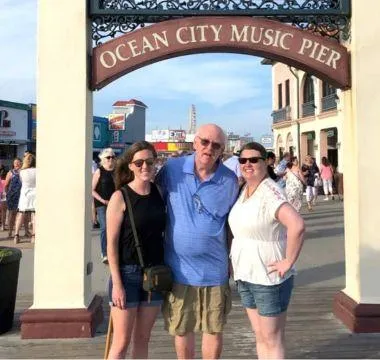
An interview with Christine Rowley, From Caregiver to Advocate: A Nurse’s Journey with Parkinson’s.
Biography
I’m a registered nurse in general neurology, and I’m also a mom of two. I earned my BSN from William Paterson University of New Jersey. My path into this field started at my father’s side, caring for him through his own Parkinson’s journey.
Can you tell me more about your Advocacy?
I serve as a Parkinson’s Foundation Ambassador for the NJ/PA chapter and sit on the Foundation’s Continuing Education Advisory Board, where I help review content for education programs for healthcare professionals. I’m also part of the planning committee building a new online course on age-friendly hospital care using the Parkinson’s Foundation Hospital Care Standards. Within my own hospital system, I’ve been working to get standardized Parkinson’s medication protocols built into our EMR.
What is your passion and how did you get involved in Parkinson’s awareness and hope for a cure?
My passion comes from caring for my father, who lived with Parkinson’s, and watching how much even small gaps in hospital care, like a dose of medication given a little too late, could set him back. That experience became the focus of my BSN capstone on inpatient Parkinson’s medication safety, and it’s what keeps me working toward a future where no one has to fight for the right care at the right time.
What type of goals does individuals with Parkinson’s have when working with you?
Most of the people I work with want to feel like partners in their own care rather than passengers. They want their care team to understand that medication timing is critical. A lot of it comes down to helping them and their families feel confident advocating for themselves, especially during a hospital stay.
What type of training and how long are the programs?
Right now, my focus is on professional education. I’m helping build an online course for healthcare providers on age-friendly hospital care using the Parkinson’s Foundation Hospital Care Standards, offered through the Foundation’s continuing education program. It’s designed to be practical and self-paced, so nurses and other staff can apply what they learn directly at the bedside.
What effect can your Advocacy have on an individual with Parkinson’s?
When hospital staff understand Parkinson’s medication timing and general care needs, it can mean the difference between a sense of stability from the home to the hospital environment, or losing ground they may never fully get back. Families feel it too because they see their loved one treated as a whole person, not just a diagnosis.
What would you like to see as a future goal for your Advocacy?
My biggest goal is to see standardized Parkinson’s medication protocols built into hospital EMR systems everywhere, not just where I work and not just a handful of hospitals, so timing-critical dosing isn’t left to chance no matter which hospital someone walks into.
What events do you participate in?
I am involved with the NJ/PA chapter of the Parkinson’s Foundation. I participate in Moving Day events, volunteering to educate patients and their loved ones at support groups, and community outreach. I am attending the foundation’s annual Volunteer Leadership Summit in Dallas, TX next month to broaden my network with other volunteers who are working towards similar goals.
How does this also assist the caregivers?
So much of my advocacy is shaped by watching my mom, who was my dad’s primary caregiver, and by seeing how easily caregiver burnout can happen. When I talk with caregivers now, I try to remind them that asking for help and taking a few minutes for themselves is not a sign of failure. Rather, it’s part of caring well for someone else.
How can someone get in touch? What is your website?
I am on LinkedIn https://www.linkedin.com/in/christine-rowley-bsn-rn-832569345/
How can others also become advocates for awareness?
You don’t need a nursing degree to advocate. You just need your story. The Parkinson’s Foundation Ambassador program is a great starting point, and beyond that, showing up at a local chapter event, sharing what you’ve learned with your own care team, or simply talking openly about Parkinson’s in your community all count.
What’s one thing you wish every nurse understood about Parkinson’s care?
Timing is everything. Parkinson’s medications work on a tight schedule, and even a fifteen-minute delay can undo hours of symptom control. It’s a small clinical detail with an enormous impact on someone’s day.
In your opinion what is the key to effective advocacy?
Effective advocacy is equal parts credibility and heart. You need the clinical knowledge to be taken seriously in a hospital setting, but lived, personal experience is what makes people listen and change how they practice.
How can we better fundraise to support a cure for Parkinson’s?
I think the strongest fundraising comes from pairing real stories with concrete asks. By showing donors exactly what their gift funds are, whether that’s a caregiver support program or a hospital education course, this can build much deeper, longer-term support than a general appeal.
What other activities do you undertake to help improve and support your daily living Eg exercise and alternative remedies?
Outside of my clinical work, I try to stay active most days – walking, some at-home strength training, and working toward a 5k – because I’ve seen firsthand how much movement and stress management matter, both for my own wellbeing and as an example for the families I work with. Faith and time with my kids are also a big part of how I recharge. I volunteer with my daughter’s Girl Scout troop, and I also work in advocacy for autism acceptance and awareness as my son was recently diagnosed.
Why should people who don’t have Parkinson’s care about this?
Parkinson’s touches far more people than just the person diagnosed – it reshapes entire families, the way mine did – and the hospital care standards we fight for benefit anyone who might one day need a hospital stay for a neurological condition, not just Parkinson’s.
Have you had any family members or relatives affected by Parkinson’s disease?
Yes – my father lived with Parkinson’s, and my mother was his primary caregiver. Supporting them through that experience, while also working full-time, juggling my own family needs, and finishing my BSN, is really the root of everything I do in this space today.
If you had one song that would tell us more about you or represent your life, which song would it be?
“Landslide” by Fleetwood Mac has always been one of my favorite songs, but it’s taken on new meaning as an advocate. No matter where this journey leads, my dad and his story keep me moving forward and keep me accountable to why I do this work. It’s a lot to carry alongside being a parent and working full time, but I believe there’s a reward on the other side: raising awareness for Parkinson’s advocacy, moving closer to a cure, and building better care for the providers who serve this community.
What are your social media tags?
LinkedIn https://www.linkedin.com/in/christine-rowley-bsn-rn-832569345/
If you had one final statement or quote you could leave for the Parkinson’s community, what would it be?
Parkinson’s may set the pace some days, but it doesn’t get the final word. With the right care, the right advocates, and a community that refuses to look away, there is real hope ahead.
TogetherForSharon® In memory of my mother, Sharon to voice awareness & hope for a Parkinson’s Disease cure. Sharon’s Son, George
Support https://www.togetherforsharon.com/shop/
Would you like to share your journey! Reach out and together our Voices are so much STRONGER!