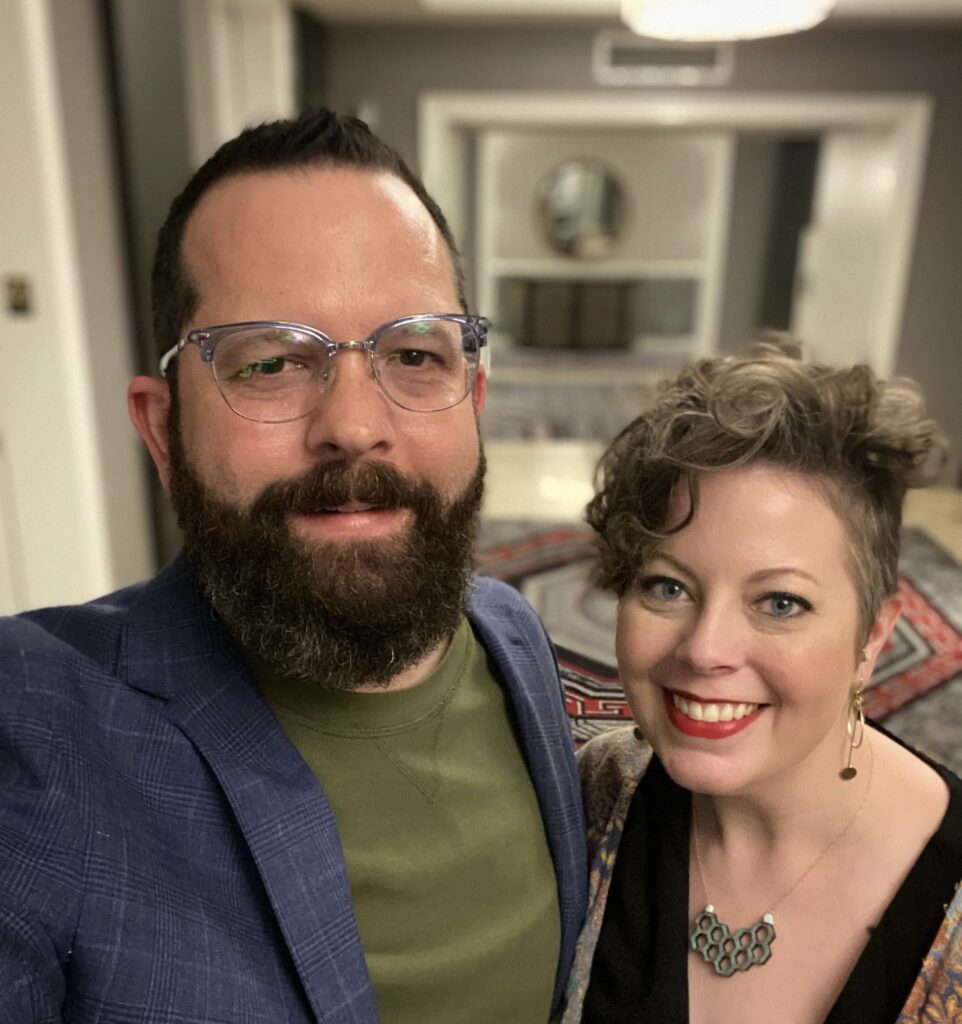
An interview with Tara & Alan Compton, More Than a Diagnosis: Finding Connection, Strength, and Community
Biography
My name is Alan and I’ve been a percussionist for about 40 years or so. For the last 21 years I have worked at a locally-owned, 105-year-old music store as a buyer and institutional salesperson. I spent most of my school years playing in marching band and I majored in music in college. This all led to a professional career in music. I spent 11 years with a company called Star of Indiana, which started as a competitive drum and bugle corps, but transitioned to a stage show called Blast!. During my time performing with Blast! we spent 7 months in London, had a brief American test tour, and then a 6-month stint on Broadway, which was unfortunately closed due to 9/11. I spent the next 20 years or so playing percussion in local cover bands, as well as a Brazilian Choro trio.
In early 2020, at age 47, I started to notice a tremor in my left hand. I decided it was probably an essential tremor, as my grandmother had one my whole life. This diagnosis was confirmed by a neurologist shortly thereafter.
I was put on primidone to help with tremor, but unfortunately the tremor began to get worse and also changed over the next 4 years. Not only was it shaking while doing tasks, but it was also shaking while I was doing nothing at all. I was also having issues with my gait, my posture, dyskinesia, and some memory and thought derailment. My neurologist decided to send me for a DAT scan which confirmed Parkinson’s Disease.
I did not start carbidopa/levodopa right away though. My wife, Tara, and I had questions and the neurologist I was seeing had more of a one-track view to treating Parkinson’s. I began seeing a new neurologist about 6 months after my original diagnosis. Tara and I were much more pleased with this doctor and I proceeded with carbidopa/levodopa and the discussion of possible focus ultrasound or deep brain stimulation.
After about a year of being on the medication, which helped considerably with my gait, postural issues, and dyskinesia, it wasn’t really helping my tremor, of which it was decided I still had an essential tremor but also a Parkinson’s tremor. We then decided to proceed with the focused ultrasound treatment. To say this procedure was life changing is an understatement. It has given me back function in my left hand. While it has regressed to a beginner hand with percussion, I’m trying to build back the coordination. I still have the occasional essential tremor while typing or reaching for things, but we warned about this. Essentially, the area of the brain that causes the tremor is destroyed by the ultrasound and if it heals back too well, some of the tremors can return. Thus far, I’ve only had minimal issues with it. I am still taking my carbidopa/levodopa, but I was able to reduce the dosage.
I told Tara just the other day that I’m fortunate enough now to not really feel like I have Parkinson’s.
Can you tell me more about your Advocacy?
We decided on starting our nonprofit, Grind City Parkinson’s Project, for a few reasons. After my diagnosis, we really felt like we needed to do something to be involved in some kind of advocacy. Then, in early 2026, Tara’s work partner and close friend, was also diagnosed with Young Onset Parkinson’s. At that point, we began our plan to start a nonprofit.
Our main goal is fundraising for Parkinson’s research. We have numerous community-based event ideas that will appeal to all ages and interests. Hopefully by getting more community involvement, we can spread even more awareness and raise money for a cure.
What is your passion and how did you get involved in Parkinson’s awareness and hope for a cure?
Our passion is to bring awareness to the fact this disease isn’t just affecting the older demographic now. We want people, not to be scared, but to be proactive if they are having symptoms, that could possibly be Parkinson’s, to get checked out. Treatments will only continue to advance and hopefully with government funding and fundraising, we can work towards finding a cure.
What type of goals does individuals with Parkinson’s have when seeing your Advocacy?
Hopefully when people see our nonprofit, they see an organization that is trying to bring awareness to Parkinson’s, more specifically young onset, but also see a community of people that are supportive of not only those with Parkinson’s but of their loved ones and caregivers too. We want people to be able to find a place that they belong to.
We have plans for working with local organizations and businesses for pickleball tournaments, exercise programs, health education programs, mental health programs, craft projects, music nights, game nights, and general hang out nights. We just launched our first fundraiser, a virtual 5K, that will hopefully become a yearly event. We want people to be able to live their lives and enjoy what they have always done, even though it may look a little different than it used to. We plan to do this while also fundraising to help work towards a cure!
What would you like to see as a future goal for your Advocacy?
For the future, we want to be an organization that is not only helping spread awareness and raising money for Parkinson’s, but we also want to form a community where people feel like they belong, are supported, can get involved, and not feel like an outsider because of their condition. You are not alone in this fight.
How does this also assist the caregivers?
GCPP is also a place for caregivers. They are in it to win it just as much as their loved one. Since Parkinson’s looks different for every individual, caregivers’ routines will also vary. We want to be there to help support them in any way we can. We want to be a resource for their needs as well.
How can someone get in touch? What is your website?
Our email address is grindcityparkinsonsproject@gmail.com
Our website is grindcityparkinsons.org
We are on Instagram @grindcityparkinsons and TikTok @grindcityparkinsons
How can others also become advocates for awareness?
Anyone is welcome to contact and help with volunteering or organizing at our events. We’re starting small this year, but next year we have big plans. There’s only 5 of us so far, so any help we can get would be fantastic!
In your opinion, what is the key to effective advocacy?
We think community involvement and awareness is key. If no one knows about your organization, they can’t support it.
How can we better fundraise to support a cure for Parkinson’s?
GCPP is trying to think outside of the box when it comes to fundraising. We’re going with the tried and true 5Ks, but also pickleball tournaments, benefit concerts, board game nights, brewery nights, and craft nights. We have ideas that will involve the community joining in while raising money and learning about our cause.
What other activities do you undertake to help improve and support your daily living? Eg exercise and alternative remedies?
Diet, supplements, exercise, and brain games are what I concentrate most on. Gut health has a lot to do with how your body responds to things, so I try to make sure I’m putting good things in my body. I take supplements to help with things my body is low on, especially the B vitamins. Exercise to keep me moving because I have a desk job, so I’m primarily seated most of the day. And definitely games to promote memory health.
Why should people who don’t have Parkinson’s care about this?
Parkinson’s is one of the fastest growing neurological conditions. It’s not just a condition that affects older generations anymore either. This is becoming a more real and present concern. If we’re going to cure it, we need all hands-on deck. Even if you don’t have Parkinson’s, you probably know someone who has it.
Have you had any family members or relatives affected by Parkinson’s disease?
We do not actually have any family with Parkinson’s, but we do have a few friends and associates that have been recently diagnosed.
If you had one song that would tell us more about you or represent your life, which song would it be?
“The Boy in the Bubble” by Paul Simon. Because it’s about living in a world of technological wonder, but also strife and adversity, and still trying to find hope and humanity inside it.
If you had one final statement or quote you could leave for the Parkinson’s community, what would it be?
Don’t fight this battle alone. Find ways to create community if you can’t find it. Peer support is crucial.
TogetherForSharon® In memory of my mother, Sharon to voice awareness & hope for a Parkinson’s Disease cure. Sharon’s Son, George
Support https://www.togetherforsharon.com/shop/
Would you like to share your journey! Reach out and together our Voices are so much STRONGER!