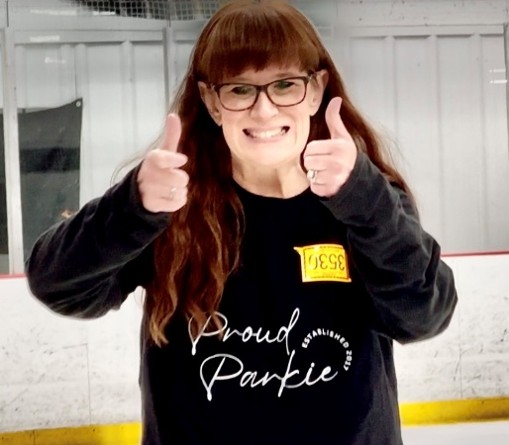
An interview with Ellen Stadler, The Cards I am Holding
Biography
I was diagnosed with Young Onset Parkinson’s Disease (YOPD) in November 2017 at age 46 as my 25-year marriage was coming to an end, and I still had two children living at home. Like many people newly diagnosed with Parkinson’s, I was uncertain about what the future would hold.
Nine years later, I am a math professor, wife, mother, Parkinson’s advocate, and clinical trial participant. I am mom to three amazing adult children, Libby (wife Kate), Nate, and Sarah who are the lights of my life and can always make me laugh. In June 2024, I married the love of my life – someone I actually knew in middle school and together we enjoy traveling, going to concerts, and finding humor and joy in everyday life. He truly brings me peace. Together, my husband, children, family, and friends help me navigate the challenges and joys of living with Parkinson’s.
Please tell me a little about your background.
I was born in Pittsburgh, Pennsylvania, in 1971 and spent my childhood growing up near Cleveland, Ohio. I earned my Bachelor of Science in Mathematics Education from Bowling Green State University in 1991 and my Master of Arts in Mathematics from The Ohio State University in 1996. I lost my father to prostate cancer in 1991 and my mother to complications from blood clots following knee replacement surgery in 1998. As an only child who lost her parents way too young, I learned early the value of independence, but I was also fortunate to have friends who became family. My college friends Janet, Jenni, and Michelle, along with their spouses Jen, Chad, and Sam, have become my chosen sisters and family. Their love, friendship, and support have been constants throughout every chapter of my life.
Can you tell me more about your advocacy?
My advocacy focuses on education, awareness, hope, and helping people see the person beyond the diagnosis. I share my Parkinson’s journey through my blog (which I have kept since my diagnosis), our newly created Parkie In The Wild puppets, designing custom T-shirts for Parkinson’s Awareness, and participation in research studies. I want newly diagnosed individuals to know that a Parkinson’s diagnosis is not the end of their story. It is the beginning of a new chapter.
What is your passion and how did you get involved in Parkinson’s awareness and hope for a cure?
My passion is helping people find hope. Shortly after my diagnosis, I started sharing my experiences through my blog, Proud Parkie 2017, because I wanted others to know they were not alone. Over time, I became involved in clinical research, Parkinson’s Foundation programs, and advocacy opportunities. I believe awareness and research participation are critical to finding better treatments – and ultimately a cure.
What type of goals does individuals with Parkinson’s have when working with you?
Many people are looking for hope, practical information, and someone who understands what they are experiencing. Some want guidance on exercise, clinical trials, or navigating life after diagnosis. Others simply need reassurance that it is still possible to live a meaningful, productive, and joyful life with Parkinson’s.
What type of training and how long are the programs?
My advocacy work includes training through the Parkinson’s Foundation Ambassador Program and years of lived experience as a person with YOPD. I also draw from my participation in multiple clinical trials, support groups, educational conferences, and patient advocacy initiatives.
What effect can your advocacy have on an individual with Parkinson’s?
I hope it helps people feel less alone. Parkinson’s can be isolating and frightening, especially at diagnosis. If sharing my story helps one person realize they still have a future, a purpose, and reasons to hope, then my advocacy has made a difference.
What would you like to see as a future goal for your advocacy?
I would like to expand awareness of Young Onset Parkinson’s Disease, encourage more participation in research studies, and help change public perceptions of Parkinson’s. I also hope to continue using social media and storytelling with puppets to reach people who might never attend a support group or educational event. In addition, I would like to be involved with policy change and support.
What events do you participate in?
I participate in Parkinson’s Foundation programs, awareness events, support group activities, fundraising efforts, clinical research initiatives, and community outreach opportunities. I also speak about my personal experience living with YOPD and the importance of research participation.
How does this also assist caregivers?
One of the goals of Parkie In The Wild is to help caregivers feel seen, heard, and understood. Parkinson’s doesn’t just affect the person with the diagnosis. Through the husband puppet character, we share the caregiver perspective with humor, honesty, and compassion. He asks the questions many caregivers have, experiences the frustrations and fears that often go unspoken, and demonstrates practical ways to support someone living with Parkinson’s.
I hope caregivers see themselves in his character and realize they are not alone. At the same time, people with Parkinson’s gain a better understanding of what their loved ones experience. By showing both sides of the journey, we can encourage stronger communication, greater empathy, and healthier partnerships. Parkinson’s may happen to one person, but the journey is shared by the whole family.
How can someone get in touch? What is your website?
People can connect with me through my social media channels. My website/blog is Proud Parkie, where I share my Parkinson’s journey, lessons learned, and messages of hope.
How can others also become advocates for awareness?
Everyone can be an advocate. Share your story, participate in awareness events, volunteer with Parkinson’s organizations, support research, educate others, or simply have conversations that challenge misconceptions about Parkinson’s. Personal stories are one of the most powerful tools we have.
In your opinion, what is the key to effective advocacy?
Authenticity. Facts are important, but stories change hearts. Effective advocacy combines personal experience with education and hope. When people connect emotionally, they are more likely to act.
How can we better fundraise to support a cure for Parkinson’s?
We need to help people understand that Parkinson’s is the fastest-growing neurological disease in the world and that research is making real progress. Connecting fundraising efforts to personal stories and tangible research outcomes helps people see the impact of their support.
What other activities do you undertake to help improve and support your daily living (e.g., exercise and alternative remedies)?
Exercise is my most important therapy. I walk regularly, participate in water aerobics, and continue activities that challenge both my body and mind. I also focus on sleep, stress management, social connection, and maintaining a positive outlook. While medication helps manage symptoms, exercise has been one of the most powerful tools in my Parkinson’s journey. I also still work full time, and my doctors think that this “forced activity” has kept my progression slow.
Why should people who don’t have Parkinson’s care about this?
Because Parkinson’s affects entire families, workplaces, and communities. Nearly everyone knows someone who has Parkinson’s or will in the future. Supporting research today could benefit millions tomorrow. Parkinson’s awareness is not just about helping people with the disease – it’s about building a future with better treatments and ultimately a cure as well as prevention.
Have you had any family members or relatives affected by Parkinson’s disease?
Yes. I have two uncles and a grandfather who were diagnosed with Parkinson’s disease. Looking back, I also believe my mother displayed many Parkinson’s-related symptoms before her death at age 63. This family history has strengthened my commitment to advocacy and research.
If you had one song that would tell us more about you or represent your life, which song would it be?
Long before Parkinson’s became part of my story, Live Like You Were Dying was one of my favorite songs. Its message about slowing down, appreciating the people you love, and making the most of every day always resonated with me. After my diagnosis, those lyrics took on an even deeper meaning. Parkinson’s reminded me that none of us are promised tomorrow, so I’ve become more intentional about finding joy, creating memories, advocating for others, and saying “yes” to the things that truly matter. The song isn’t about giving up – it’s about choosing to live fully, no matter what challenges life brings.
What are your social media tags?
TikTok: @ParkieInTheWild
Instagram: @ParkieInTheWild
Facebook: Parkie in the Wild
X: @ParkieInTheWild
YouTube: @ParkieInTheWild
If you had one final statement or quote you could leave for the Parkinson’s community, what would it be?
“You don’t have a right to the cards you believe you should have been dealt. You have an obligation to play the hell out of the ones you’re holding” ~ Cheryl Strayed
TogetherForSharon® In memory of my mother, Sharon to voice awareness & hope for a Parkinson’s Disease cure. Sharon’s Son, George
Support https://www.togetherforsharon.com/shop/
Would you like to share your journey! Reach out and together our Voices are so much STRONGER!