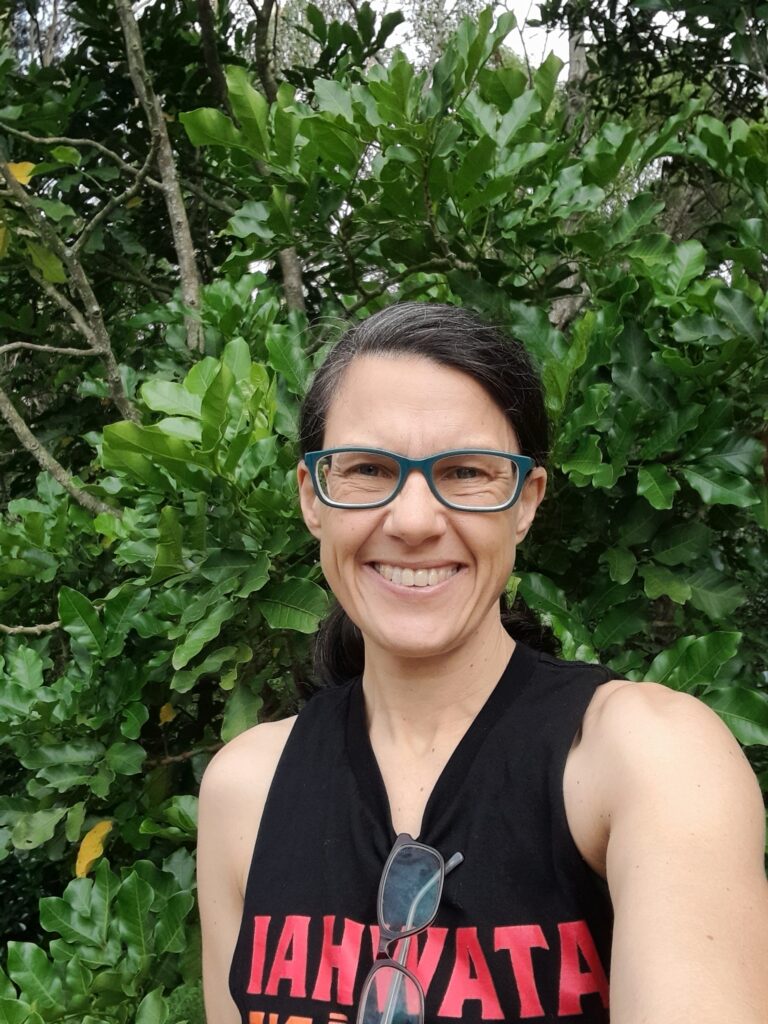
An interview with Emma Kyriacou: My Ordinary Life Living with Parkinson’s
Biography
I am 47 and I live in Kāpiti in Aotearoa/New Zealand. I first noticed the physical symptoms of Parkinson’s in 2008 at the age of 29, but not correctly diagnosed until 2018. In 2018 at the age of 40 I took up karate and achieved my Shodan (black belt) in February 2026.
Please tell me a little about your background.
I am a writer, a karateka and podcaster. I studied at the University of Auckland and had a career in the public service in Wellington, and retired about a year ago to focus on my health, and in particular to devote a large part of my time to exercise and karate training. I also joined a podcast called “Ordinary Life” about living with Parkinson’s created by my close friend Kitty Doyle (who also has Parkinson’s).
Can you tell me more about your Advocacy?
In Aotearoa the prevailing view is still that Parkinson’s is an older (and mostly male) person’s illness. This view is perpetuated in the media, by the community, and even by the national non-profit organization set up for Parkinson’s. In the podcast Kitty and I talk about how what we look like does not equal how we feel, and also that Parkinson’s does not discriminate. It affects people of all ages, genders, and ethnicities. Through the podcast we also highlight that the voices of people living with Parkinson’s matter, and the importance of exercise. Our message is that although we aren’t medical experts, we are experts on us. We give people practical support on what it takes to live with Parkinson’s. We try to be positive, although we are human, and sometimes it gets us down, laughter really helps. We also promote the idea that although fear is real thing, it is possible to live a good life and not let fear dictate the terms.
What is your passion and how did you get involved in Parkinson’s awareness and hope for a cure?
The entry point for me in getting into raising awareness was through meeting Kitty. We were introduced by a mutual friend who discovered we both have Parkinson’s. Someoneclose to someone who is so much like me (we are same age group and gender, both experiencing similar things around relationships, parenting, and so many other things), has been enormously helpful for us both. I also am passionate about karate and its positive effects in my life.
What type of goals do individuals with Parkinson’s have when seeing your Advocacy?
What type of training and how long are the programs?
What effect can your Advocacy have on an individual with Parkinson’s?
I hope that it makes people feel less alone and gives them hope.
What would you like to see as a future goal for your Advocacy?
I’d really like to set up a peer-to-peer networking support group for people with young onset Parkinson’s for people in Aotearoa/NZ. Kitty and I have both noticed that there is a dearth of support and resources on living well with Parkinson’s in our country, and a dearth of social support particularly for younger people. Where we live the focus of the Parkinson’s support groups are on older age groups.
What events do you participate in?
None. (Not sure which events you are referring to?).
How does this also assist the caregivers?
To be honest in our country so much of the focus is on caregivers and their needs, and the voices of people who have Parkinson’s are marginalized. So in terms of what Kitty and I talk about and do our focus is on our needs. I think this does actually caregivers to see those they care for as intelligent people who can express their own opinions and views, and not be talked for.
How can someone get in touch? What is your website?
ordinarylife.co.nz, or I can be emailed on emmaordinarylifepd@proton.me
Instagram = @emmaordinarylifepd
Facebook = @Ordinary Life or @Emma Kyriacou
Bluesky = @emmaordinarylifepd.bsky.social
Threads = @emmaordinarylifepd
How can others also become advocates for awareness?
Get on social media and talk about your story and your perspective.
If you could add any questions to this interview that you may want others to learn about, what would the question(s) be?
What are you passionate about? What brings you joy? What do you do to have fun?
How can we better fundraise to support a cure for Parkinson’s?
I’m not currently involved in fundraising or even thinking about curing. I use all of my available energy and resources on day to day living, exercising, parenting, and doing Ordinary Life and other voluntary work.
What other activities do you undertake to help improve and support your daily living Eg exercise and alternative remedies?
I have a really long formula for wellness, which keeps growing! If I sum it up to the highest level and keep to the most important elements, it is: exercise (an exercise routine that becomes progressively more difficult, and incorporates doing 2 tasks at once while you are moving, e.g. karate, dance, as well as strength building/resistance work, aerobic /intense cardio, learning/skills development (progressive challenges, skill training, focus on a goal includes learning, having success, getting feedback), flexibility, balance, and large amplitude) + sleep (get enough in darkness) + take medication at right times + get good nutrition (which for me includes eating small regular meals to get enough but not too much energy and protein, minimise ultra-processed food) + get social + have fun.
Why should people who don’t have Parkinson’s care about this?
Its good to be aware of how people with chronic illness and disability view the world.
Have you had any family members or relatives affected by Parkinson’s disease?
None that I’m aware of.
If you had one song that would tell us more about you or represent your life, which song would it be?
CHAMPION by Bishop Briggs.
If you had one final statement or quote you could leave for the Parkinson’s community, what would it be?
You are the world’s foremost expert on you, don’t be afraid to share this with the world and your community.
_____________________________________
TogetherForSharon® In memory of my mother, Sharon to voice awareness & hope for a Parkinson’s Disease cure. Sharon’s Son, George
Support https://www.togetherforsharon.com/shop/
Would you like to share your journey! Reach out and together our Voices are so much STRONGER!